
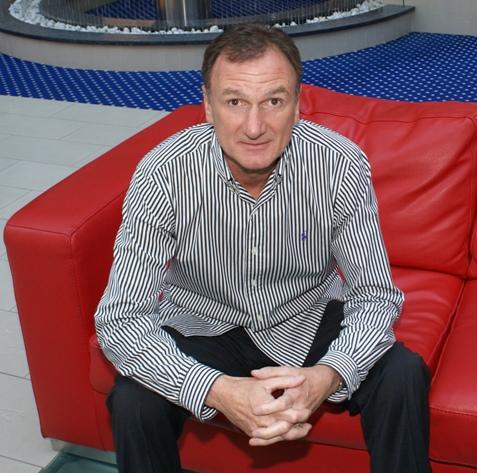
Image by Arnie - Copyright LFChistory.net
Phil Thompson was a player at Liverpool for 14 years captaining Liverpool to European glory in Paris in 1981. In total Thompson spent 25 years at the Reds as player, captain, reserve team trainer, assistant manager and acting manager. Tommo is a true Liverpool legend. In this first part of our interview with Tommo we will focus on his playing career, reflecting on his coaching years in our second part published a week from now.
Being brought up in Kirkby...
It shaped me very much. It was a tough area, really tough area. You had to stand on your feet, have your own mind and stand up for yourself. In footballing terms there were some fantastic talent in Kirkby, in abundance. Dennis Mortimer who lifted the European Cup for Aston Villa went to the same school as me, Brookfield school in Kirkby. Just incredible you've got two captains at different clubs that went to the one school, that's probably a record. In those early days there was players galore all playing for different football clubs.
It was a very young town and football was the only thing you had. There wasn't any other sports. Everybody played football 24-7. It shaped you like that, you had to compete with some fantastic players. Being quite skinny, I had to have more drive and determination than the next fellow, so it shaped me very much my early days.
You have always been a Red through and through.. No Blues in you family?
My dad was an Evertonian. Once I started playing for Liverpool he turned. There were seven children in the family, two brothers and four sisters. Big family, there was a lot of big families in Kirkby at the time. Fantastic childhood. My mum was a massive Red. As a youngster her and her twin sister used to stand right next to the dug-out and they were there week in and week out. She was very passionate about her football and very much Liverpool, so we followed in her traditions cause my dad was a merchant seaman. We didn't see him a lot of the time, he was away. We followed my mum.
When I saw young Phil I decided he had tossed up with a sparrow for his legs and lost.
He was not the strongest boy in the world, but he had heart.
The ability was there, plus the ambition and the passion, the will to win. - Bill Shankly
First contract....
I was age fifteen. There were other boys of fifteen who had already signed apprentice. I had been six weeks on trial and wanted so desperately to sign. Tom Bush took care of all the young players. I played the first game of the season for the B team against Bury. After the game I said to my mum: 'I can't go on like this'. I had played very well. My mum said: 'I'll have a word.' She said to Tom Bush: 'What's going to happen with my son? He's been here six weeks and we think it's long enough now.' He said: 'Don't worry, don't tell him tonight. We're going to sign him on apprentice forms tomorrow.' My mum couldn't wait and leave it for the next day so she told me when we were on the bus.
All the young lads wonder whether they would turn professional. It is always a very difficult time. They would always do it on your seventeenth birthday. My birthday is January 21st. This was December and I had been injured. You had heard all these stories about Shanks, if you were injured he didn't want to know. We didn't have people to give you rehab in those days and you were left to your own devices. I had a groin injury and was just walking around the B team pitch. Shanks came over to me and I thought 'He's going to give me a bollocking here.' He said: 'How are you, son? Are you sleeping well? Are you eating well?' 'Fine, boss', I said. Then he said: 'Your birthday is January 21st.' My eyes lit up that he actually knew my birthday. I thought he was going to send me a birthday card. He said: 'I just want you to know not to worry. We have been more than pleased with how you have performed. Just to put your mind at ease, we will be signing you as a professional on your 17th birthday.' You can imagine that I couldn't wait to get home and tell them. It was a fantastic and a big, big day.
I was seventeen then. Lo and behold, by my nineteenth birthday I had won the UEFA Cup, the League championship, the Central league with the reserves. It was incredible. I had played in a mini world cup final for England against West Germany in the Nou Camp. It was just fantastic. All in a couple of years from the age of seventeen to nineteen. Does it get much better?
Tommo's debut was vs Manchester United on 3rd of April 1972
I played against George Best. He tried to nutmeg me right in the centre circle. I was very clever as a lad and I closed my legs. The ball bounced off my shins.
You were still a massive fan of Liverpool when playing for the club...you were making flags before the 1974 FA Cup final.
That's it. Do you see people ever doing that now? Steven Gerrard, maybe Jamie Carragher might do, but there's me and my mum. We've got a big sheet on the floor. We made two flags and we are putting on all the tape. 'Shanks' Red Army.' That's prior to the FA Cup final in 1974. That will never ever happen again. I felt great pride in doing these flags for my brothers to take down to Wembley. That was fantastic.
Liverpool beat Newcastle comprenhensively 3-0 on the day in 1974 at Wembley and 20-year-old Phil Thompson was praised for keeping the great Malcolm MacDonald quiet. Thompson had played about 70 games for Liverpool, but the local policemen were not so familiar with Tommo when he was going to pick up winner's medal at Wembley.
I swopped shirts with Terry McDermott and had a Newcastle hat. I was looking to go up the steps to try and get my medal. The police thought I was a Newcastle player and they were trying to sort of ease me away and wouldn't allow me to go up the steps. I think they were trying to put me in place. 'You go up second.'
The breakthrough...
I was always a midfield player. I was more defence-minded as a midfield player and every now and again if the reserves were short Ronnie Moran played me at centre-half. I played a few games, but I never played centre-half in the first team. When Larry Lloyd got injured and he was out for quite a while we had a guy called Trevor Storton who played and he didn't make a good job of it. Larry tried another comeback, damaged his thigh muscle again so lo and behold out of blue, Bill Shankly said to me: 'I want you to play centre back for the first team.'
That was not just the case of moving one guy back in defence, it shaped a whole new playing style.
Exactly. People always say it was the Dutch who gave Total football. I say it was Liverpool. Emlyn and myself were not centre-halves like Big Yeatsy, big Larry Lloyd just as a stopper. It was now a totally new ball game. It was Ray Clemence rolling the ball out to me or Emlyn and we pass it and we go across one side, we go across the other side. We'd probe and pass. We used to keep the ball for fun in those days. We always used Ray Clemence as an option. Pass it to him and he would throw it to the other side. It was always keeping possession of the ball. The decision shaped the way Liverpool is of now. We won so many trophies. People couldn't get the ball of us for minutes on end.
Bill Shankly was very forward thinking. When I played my very first game when I came on as a substitute against Manchester United at Old Trafford, Tosh had come off injured and Bill Shankly said to me: 'Play behind Kevin Keegan', so it would give us a bit of strength in midfield. So I was like "number 10" as people called. This was very forward thinking. Not many people had gone for that sort of role. It was quite modern and up-to-date in how he saw his tactics.
Any favourite Shankly stories?
I loved the guy. My own particular story was from those early days when I was a midfield player. I played a few games and we were playing Arsenal at Anfield. I played the week before and when the teams were announced I was substitute. I was only nineteen. We got beat 2-0, John Radford and Alan Ball scored the goals. After the game Ronnie Moran stopped me in the corridor and he said: 'Have you asked Shanks why you didn't play?' I said: 'Ronnie, I am only 19 years of age. I don't have any sort of rights to be playing regularily.' And he said: 'It's not just that, son. Shanks will think more of you if you go and ask him why didn't you play.' He will think: 'That's what I want to see. A fellow who has got balls.'
I went home and spoke with me mum and said: 'What do you think?' Ronnie was my mentor and she said: 'If Ronnie says that, you should go and do it.' So, Monday morning I pluck up the courage. Shanks is just coming out of his office so I go to him and he says: 'Yes, son. What can I do for you?' 'Can I have a word, boss?' I go into his office and he says: 'Yes, son. What is it?' What can I do for you?' 'I would like to know why I didn't play on Saturday?' 'Jesus Christ, son, you wanna know why you didn't play on Saturday? You should be in here thanking me for not playing ya!' That load of rubbish out there on Saturday are finished. Your Smith, your Callaghan, your Lawler. They are all finished. They're all has-beens. They have no chance. But you, son, are going to play for this football club for many years to come. You are going to captain this football club, you are going to play for your country and don't be surprised if you are going to captain your country. Jesus Christ almighty, son! You should be here on your bended knees thanking me for not playing ya!'
I never said any more words. I just got up. I bowed. I walked out and honestly my head was so big I caught my head on the door frame and felt absolutely ten foot tall. The only problem was he still picked the same team the following week. That was his psychology. That was how clever he was. Shanks built you up and he knew how to do it. But he also knew the other players and he gave them another chance.
First game as captain...
Emlyn was coming to the end of his career at Liverpool. He had been injured and out of the team. It was amazing... Bob made Kenny Dalglish captain. All the players were absolutely astonished. Alan Kennedy, Terry McDermott and everybody were saying to me 'We can't understand why he hasn't made you captain.' I was gobsmacked. Kenny was captain for about 5-6 games and then we were playing Arsenal at home and Bob said: 'I'm changing the captain. Phil is going to be captain.' I was so pleased and thrilled. I can always remember Phil Neal's words to me: 'Tommo, that shouldn't even had been an issue. There is only one person who has the divine right to be captain at this moment in time and that's you.'
On that day we were playing Arsenal at Anfield. I went down the steps at Anfield, touched the sign. I came up the steps. I go out on the pitch, straight over to the edge of the penalty area. What I had in my mind was that my brother, Owen, was on the Kop. I was looking for my brother. I hear everybody laughing. Clapping first and then laughing. I am thinking: 'What's going on here?' I am waving to my brother and I turned round and the players were still in the tunnel. They allowed me to walk out on my own. They were killing themselves laughing.
There were two things. A) We always liked a laugh. B) They knew how important the captaincy was to me. I was extremely proud.
Who was the best laugh?
Terry was a bundle of laughs. Some good stories I have of him you can't print! Terry used to take off and skit Bob Paisley. How he spoke, how he walked with this swagger of his arm from side to side. We used to giggle and have a great laugh.
Bob Paisley was very clever. He allowed us to enjoy ourselves. There were rumours about us socializing too much. If Bob had to, he would say: 'Calm down a bit.' But he knew what made Liverpool great and that was the camaraderie. Once it started taking effect on the pitch, that's when he would have you in his office and give you a rollocking! Discipline was a mainstay in what we did, but we'd like to enjoy us and that's why the bond was so special.
You lifted the European cup as captain, but a couple of months later you were no longer captain
I lifted the European Cup in May and then come turn of the year, Bob Paisley took the captaincy off me and gave the captaincy to Graeme Souness. I was absolutely devastated. Bruce Grobbelaar had just come to the club and Ray Clemence had moved on. We've had a great understanding. It was the most difficult time I'd had as a player. Bob thought the captaincy was part of it. In fairness he had a point. I took all the responsibility on my own shoulders. Everytime there was a goal being conceded I wouldn't allow anybody else to take the blame. It was my fault. He said I was placing too much pressure on myself. I was disappointed because I felt Graeme Souness in the background was pushing for the captaincy himself.
After hearing about his loss of captaincy to Souness from everybody else than Bob, Tommo decided to confront Bob about it in the manager's office.
I asked Bob, 'Who's going to be the new captain?' Bob said: 'Well, I'm not...' I said: 'It's Graeme Souness, I know it anyways.' Bob choked on his words, which I was disappointed by. It had the desired effect. It gave me a huge boost in my esteem to prove Bob wrong. At that point we were 18 points behind in the 12th place in the League and we went on to win the League.
Who said about you: "We always joke, that if Tommo hadn’t been a professional footballer he could have been a male nurse. Between you and me, he just about passes out at the sight of blood, even when it’s not his own!"
That's Ronnie Moran. He's always said it as whenever I've seen blood, I go: 'Oh, no!' Even if another player was cut. I would go over and 'Ohhhh!!' He would snap at me: 'Tommo!', because he knew what I was like. I was probably better with me own blood than anybody else's.
He also said about you: "I still remember Tommo’s first morning with us when he arrived with a batch of other kids. Sometimes you can instantly spot players who are going to make it all the way to the top. You could see it in him right away. His attitude was right, he was positive and he wanted to win. He was the Liverpool prototype, who did the right things without being prodded along all the time. You don’t make them, they make themselves."
Ronnie was my mentor and he was very very hard at times, but it was the Liverpool way. He accepted the criticism, he accepted the tough times because he could see the end vision. He pushed me and pushed me. Ronnie was fantastic with me. I played in the B-team with Ronnie, I played in the A-team with him, I played in the reserves with him and then we moved on to the first team. He was a tough demanding coach. We could win 5-0 on a Saturday and on the Monday morning we'd go in and Ronnie Moran would be barking out the orders. Everybody says: 'Are you never happy?' It was the right thing to do. You didn't rest on your laurels. You've won the League championship. You get bugger all for last season. That's gone, that's finished.
When Joe Fagan took over as manager at Liverpool that signalled the beginning of the end for you as a player.
It's Liverpool Football Club. You have to make to make tough decisions. You learn that when you become a manager and a coach. I believe Joe got big decisions wrong. Graeme Souness had left and I had been playing in center midfield for six months in the reserves and doing it very successfully. The year Graeme left there was a big hole in and nobody could fill it. It came to an European game away in Poland [vs Lech Poznan]. Joe had said: 'Phil will play and do the business.' Come the game, shock horror! All the other players thought I was going to be playing. And Joe left me out on the bench. His words many years later were that if he had brought me back into the team and then had to leave me out again it would damage me as a person. He'd hurt me again to leave me out.
It doesn't really make sense, does it?
It doesn't make sense. You go with what's best at the time. It had already hurt.
The other thing with Joe was the European Cup Final in '84. 17 players went over there to Rome. Dave Hodgson had had knee injuries and groin injuries. He could hardly train. When you were players I wouldn't have said to the staff: 'He's got an injury'. It wasn't like that. When the team was picked and the subs were picked I was the 17th man so I wasn't going to be involved which I was extremely disappointed in.
Worse was to come when we came out of the hotel to get on the team bus. As I stepped on to the stairs to get on the bus Joe Fagan put his arm around me and said: 'You can't come on the bus.' I was absolutely devastated. I had a lump in my throat. I was on the verge of crying. I had to walk along the side of the bus and all the players were looking at me, wondering what's going on. 'Where are you going?' I had to go on the other bus and sit next to Paul Walsh who had been signed four days before. My wife was asking what had happened. I couldn't even speak. I was so upset. I could never forgive Joe. He had to make a decision to leave me out. No problem, I have plenty of time for that, but that showed a lack of respect. I was the senior member of the squad. The players were furious.
"I regard Phil as one of the best possible examples of a true professional. His greatest asset as a player is his ability to read the game, he showed that gift even as a teenager. He is not the biggest man physically for his role in defence but his football brain is outstanding." – Bob Paisley
Next week: part 2 of our exclusive interview with Phil Thompson where he talks about his and Houllier's legacy at the club, tackles the Anelka decision, discusses the failure of Diao, Diouf and Cheyrou and reflects on the players that got away...
Interview by Arnie ([email protected]) and Sigfús Guttormsson - Copyright - LFChistory.net