
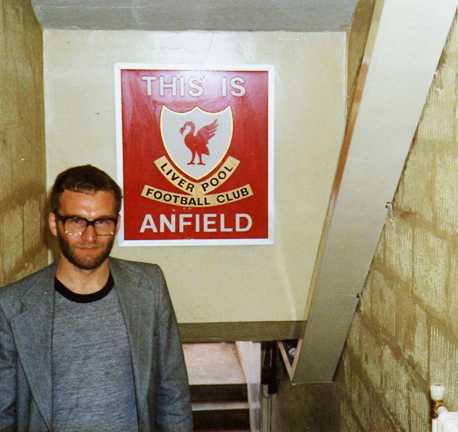
The First Time : Saturday 23rd August 1969
I had been to Anfield before … but only to sit down. In any case my opportunities for going were limited because although my home was between Chester and Liverpool my school was 200 miles away in south-west England. But the day finally came when I was allowed to travel to Liverpool on my own and it was with great excitement that I boarded the bus which would take me from Chester up to Birkenhead. From there I took the ferry across to Liverpool and then another bus up to Anfield from the Pier Head.
I had heard a lot about the Kop, seen it on television of course and observed it during my only previous visit to Anfield. But now I was actually going to stand on it myself. This was in the days before Liverpool attracted a lot of “out of town” supporters, not because there wasn’t support for Liverpool in other places but it took time for Supporters’ Clubs to get organized and arrange transport, etc. In 1969 nearly everyone who attended home games came from the immediate area because I recall that I was the only Liverpool supporter on the bus to Birkenhead and I only met one other fan on the bus going home.
At the start of the 1969-70 season Shankly’s great team of the mid-60’s was just about still going. One or two changes had been made but it wasn’t until the cup defeat at Watford the following March that many of the senior players reached the end of their Liverpool careers. Four wins in a row at the start of the season had supporters already talking about another championship. In the end that proved false but as I walked around the stadium waiting for the gates to open I wasn’t expecting anything but another victory. I deliberately wanted to go in early to savour the atmosphere and not knowing any better I stood right in the middle of the vast terrace. There was a crowd of over 51,000 on that day and I suppose I was a bit overawed by the atmosphere as the crowd built up and kick-off approached. What I hadn’t been prepared for was the sudden movement of the crowd and I quickly learned that you had to keep away from the barrier in front of you because the force of being pushed down into that with several dozen Kopites right behind you could cause some damage. But when the crowd did surge forward there was always the friendly arm of a complete stranger to help bring you back into your former position.
The teams didn’t come out early to warm-up in those days so it was a long wait before they finally emerged to a noise which to me was astonishing. You know how loud it is when you watch from another part of the stadium but it doesn’t really prepare you for the actual volume when you’re in the middle of it. I still remember a lot of the details about that game even though it took place so long ago. Tommy Smith put a penalty away at the Anfield Road end and when Bobby Graham headed Liverpool further in front after the interval it looked like being the easy victory most people had expected. But Burnley had a good side including many players who would go on to better things with other clubs and they hit Liverpool with a remarkable three-goal burst mid-way through the second period. Far from subduing the Kop it only seemed to generate more noise as they tried to get the home team back into the game and when Smith crashed an equaliser past Peter Mellor from the edge of the penalty-area everyone went wild. The volume was turned up even higher as Liverpool chased for a late winning goal but even though it didn’t come the enthusiasm and passion for Liverpool that I experienced from the people around me that day was infectious. I didn’t feel much disappointment that Liverpool had failed to win after being two goals ahead because I was completely drained by the three hours I had been standing there, covered in sweat from the cramped conditions on a hot summer’s day and exhilarated by the noise and the atmosphere. Like a drug I wanted more of it as soon as possible and it wasn’t long before I had finished school and became a regular on the Kop.
The Best Time : Wednesday 16th March 1977
This would be most people’s choice because of its importance and the sheer drama of the ending. I certainly couldn’t argue with that and even though I was sitting in the Main Stand that night if these are memories of the Kop rather than from it then I can still include it. There wasn’t much opposition when I checked back through all the games I have seen at Anfield. Although there were many memorable occasions to look back on, nothing could compare to this astonishing evening which saw Liverpool keep alive their dream of winning the European cup, a dream which was to come true a little over two months later.
The club’s previous European cup campaign in Bill Shankly’s last season as manager had ended in disappointment with home and away defeats to Red Star Belgrade. But the new players brought in by Bob Paisley were blending in well with those from Shankly’s reign and Liverpool were emerging as a team well suited to the European game, a fact confirmed by their win in the UEFA cup the previous year. However, St. Etienne were not a side to be underestimated as they had reached the European cup final in 1976, losing most unluckily to Bayern Munich. I had travelled to France for the first leg but we didn’t take nearly as many fans there as they brought to Merseyside two weeks later. The city centre was a mass of colour and noise from lunch-time onwards, especially as thousands of Everton’s fans were preparing to travel for their team’s League cup final reply with Aston Villa in Sheffield.
Thousands were locked out of Anfield as the teams took to the field to a deafening reception. But even the most ardent Liverpool fan couldn’t have expected the home team to wipe out the visitors’ narrow advantage with barely two minutes gone, Keegan floating a centre from the left over Curkovic’s head. The Kop, already in great voice before the start, roared their favourites on to get a second goal. But the Reds couldn’t keep up their early momentum and Ray Clemence had to produce a brilliant save to keep Rocheteau out. He did it again in the second half but had no chance with Bathenay’s vicious, swerving shot which put the visitors ahead again on aggregate. The unusual thing about many European games at Anfield from that era was that people in the seats who hardly said a word during league games got really involved and the singing and chanting really was from all parts of the stadium as Ray Kennedy drove Liverpool back into the lead on the night. But it was from the Kop where the most noise and passion came as they willed the team on to the final, decisive breakthrough. That support never lessened even when time was running out but when David Fairclough ran on to Ray Kennedy’s pass and kept control of the ball despite being challenged heavily it was as if the whole stadium held its breath waiting for the outcome. A second or two later the ball was in the Kop goal and 24,000 people behind it were jumping up and down and screaming with joy. Most people in the stands were on their feet for the last few minutes as well as the atmosphere generated by the Kop got through to the whole stadium. When the referee finally blew for the end of the game the noise was probably heard several miles away.
The strange thing was that when we had all calmed down we realised that all that had been achieved on the pitch was that the club was through to the European cup semi-final. Nothing had actually been won yet the initial reaction was as if the European cup had been decided on that night. Although the atmosphere created by over 25,000 Liverpool fans in Rome a couple of months later was brilliant, it’s hard to compare it with the quarter-final because Rome was a neutral venue and, at that time, there was no roof covering the terraces and that can make a big difference to the sound effect. What is certain is that, Inter Milan 1965 apart, there never has been a similar occasion when the Kop showed how much it could frighten the opposition and inspire eleven men on to a famous victory.
The Saddest Time : Thursday 20th April 1989
I didn’t go to the semi-final. It was at a time when I wasn’t able to go to many games but I remember being so nervous that afternoon that I went out for a walk just before 3 to take my mind off the game. It wasn’t any premonition that something terrible was going to happen; just the usual tension that most supporters feel before a really big game. I returned home during what should have been the half-time interval to be first confused and then horrified by the scenes that were being shown live by the BBC. At that time there wasn’t any definite news of casualties but as the afternoon turned into evening the true facts began to emerge. I spent hours on the telephone that week-end trying to find out if people I knew had been at the match were safe. Sadly four members of the London Branch on whose committee I had served for many years had died. I was also touched by so many people calling me, from as far away as America and Australia, just to make sure that I was alright.
I tried to think and talk my way through it all but when I saw the television pictures of what was happening at Anfield in the first few days afterwards I knew I had to go there too, not just to pay my respects but because I felt that only then would I really believe what had happened. It might be a painful sight but at least then I could start to grieve properly. I made the long journey from north by car with a friend and her two children. Alison was from Liverpool and she had a contact in the club who met us when we arrived. Because of that connection I did feel somewhat guilty that we had walked straight into the main entrance and past people who had been queuing patiently for a long time. But once we had walked up onto the track by the side of the pitch guilt was replaced by something else that is almost impossible to describe as I looked at the Kop goal and the area in front of it before walking on to the Kop itself.
There were thousands of people inside Anfield but almost no noise. The whole atmosphere was unreal but while standing on the Kop and looking out over the pitch I probably realised fully the enormity of what had happened. Almost every barrier on the terrace had scarves tied around it and flowers placed in front of it. To many of those tributes were attached personal messages that brought tears to your eyes just reading them, especially those placed by friends and family on the exact spot where some of the victims used to stand. I recall reading a note from a young fan who lived on the south coast and who had never been to Anfield. But he had sent his treasured scarf up with a message asking for someone to put it on the Kop with all the others. I made a note of his name and address and later sent him a card telling him his scarf was there with the rest. It would have been easy for the club to ignore such requests but they took the trouble to ensure that everything sent to them found its way out on to the pitch or the terrace. Some of those momentos must have meant a lot to the people that had sent them or took them to Anfield that week but they were prepared to let them go in memory of all their fellow supporters who had perished at Sheffield. I had a scarf with me which I had owned for years. It was just an ordinary red and white scarf. It didn’t even have the name “Liverpool” on it but it was special to me. I tied it symbolically and deliberately between two Everton scarves because their supporters were brilliant that week and showed that they were as hurt and angry as the red half of the city.
Outside the stadium there were countless messages scrawled on the walls and almost as many beautiful poems, in which was perfectly conveyed the anger and sorrow of the authors about the needless loss of life. When I returned home that evening, emotionally drained after what I had seen and physically tired by several hours of driving, I tried to put my feelings down on paper too. I hope I won’t ever forget the people who died. I know I’ll never forget the day I went to Anfield to remember them. Here’s what I wrote at the end of that terribly sad and emotional day fifteen years ago :
Standing on the Kop today
Where I have stood for twenty years
No men in red before my eyes
But just the mist of bitter tears
A broken-hearted city mourns
The dead from Sheffield’s hell-hole trap
No-one is here today to sing
No-one is here to cheer or clap
Ten thousand scarves before my eyes
A hundred thousand flowers bloomed
With words of love and tenderness
For those whom Hillsborough’s death-trap doomed
A part of me has died today
Along with those who suffered there
But what I see before me now
Must bring me hope through my despair
I had to come and share my grief
For ninety-six who won’t be home
Bill Shankly’s arms are open wide
With him they’ll NEVER walk alone
The Last Time : Sunday 1st May 1994
Thousands of Liverpool supporters assembled on the Kop for the Farewell Concert. In a way I had wanted to stand there for the final game the day before but I would never have got the same visual impact that I had from my seat in the Centenary Stand. What an amazing and unforgettable sight it was to see the whole of that famous terrace covered with thousands of scarves, banners and flags of all colours. The Kopites have never been in better form. What a pity the same could not be said of our team, who produced a sorry performance against opponents who had struggled for weeks to collect league points. But even defeat could not spoil the party and the emotional scenes before and after the game will never be forgotten by those privileged to be there.
I was glad to have one last opportunity to stand where I had stood for so many years as a Kopite. It was also important to me that a number of people I had stood beside for twenty years were there beside me at the concert too. If I felt nostalgic as I climbed the steps onto the terrace it was soon forgotten because the mood and the atmosphere already in place was one of great celebration. A lot of work and planning goes into staging a concert and considering how little time was available to the organisers I reckon they did a marvellous job. The bands who performed were all well received and it was nice to see former players like David Johnson, Phil Thompson, Tommy Smith, David Fairclough and Alan Hansen up on the stage joining in; good also that a number of current players had taken the trouble to attend and they were warmly applauded for making their way to the section at the front where some handicapped supporters were situated and distributing a number of the special gold shirts used in three away games that season but which at that time had not been available to purchase. The two hours of music seemed to go quickly and suddenly Gerry Marsden was up there on stage singing the first lines of “Ferry ‘Cross The Mersey”. Then he was straight into his song, our song and even though he must have sung it a million times in 30 years I doubt if it has ever been with more passion and feeling. He knew, as did we all, that this was something very special. As he reached the chorus the stage and the area in front of it was filled with all the performers, players and other celebrities. There were inevitably several encores, each one seemingly louder than the previous. Eventually of course it had to finish and as the bands drifted away it was possible to hear the sounds of dozen of hammers and chisels banging into the concrete steps from supporters who were not prepared to leave without a precious souvenir, not just of the day but of their lives on the Kop. I managed to get a small piece from the step I had stood on so many times but others were more determined, climbing up to remove signs much bigger than any piece of concrete. Just as on the day before it seemed like about 1,000 fans each wanted to be the last to leave the Kop but on the whole the police and stewards seemed to understand the feeling of the fans and let them stay for as long as possible before gently shepherding them away from the middle and towards the exits.
As I walked slowly off that famous terrace for the very last time and down the steep steps into Walton Breck Road it wasn’t with the emotion that I had anticipated. Perhaps that was because the concert had been so successful that nobody could really feel sad immediately after it. But as I walked out of the Kop I knew beyond doubt that I never had walked alone there in the 25 years that separated my first and last visits. Those years were filled with so many memories that thousands of us shared together, great triumphs that supporters of other clubs can only dream about and more than our fair share of tragedy too. It will never be the same sitting down but the spirit and magic of the standing Kop will live on years after the seats have been installed.
Copyright - Chris Wood @lfchistory.net