
A few years ago we had the privilege of interviewing Ian Rush and the other day we conducted our second interview with this fantastic legend. His career was of course an eventful one so there was still enough to talk to him about the second time around. The focus is on the first part of Rushie's career from when he started out at Chester until he rejoined Liverpool in 1988.

Image by Arnie - Copyright LFChistory.net
One has a portrait of you as a village boy from Wales who's always stayed true to who he is despite all his success..
My dad brought me up to respect people. One thing he always said was: 'If you're nice to people on the way up, they'll be nice with you. If you're not nice with them they'll sit and be waiting for you to come down and that's when things don't turn out nice.'
You are very religious.
I am a catholic. I go to church.
Has it helped you on the field?
I think so. At the time I didn't realise, but everything you do you sort of pray for. I have scored goals and other things have happened. On the Saturday after the game I used to drive home back to Wales and go to church 8 o'clock Sunday morning. I do believe it helped me and gave me the strength to do what I have achieved.
Liverpool and Manchester United scouted you when you were 13. Your career could have taken a very different course..
I was 13 playing for Deeside Primary schools. A Liverpool scout watched me, but we never heard anything after that. It would have been difficult for me to break into the Liverpool side as a youngster and I think my development was better going to Chester where slowly but surely taking their time to develop my career. Manchester United talked to my dad, but we already committed then to go to Chester. Once you give your word that's what you have to do.
It's hard to see a lower league player like yourself were at Chester taking this big step from fourth division to the first nowadays.
With the academies developing for the Premiership clubs they like to get the players at a very young age when they're 10-11. It's not something which I totally agree with because I do believe you can develop at different stages. It's no good telling 'you're not good enough' when you're 16, 17, 18. You can still be good enough. It's up to mental strength and mental toughness to prove that.
You tried to prize yourself out of the move when Liverpool came knocking again in 1980 by demanding an unreasonable high wage at Liverpool or so you thought...
I didn't think I was good enough to get into the Liverpool side. They had great players there and they were winning the league. I turned them down because I was happy at Chester where I was. Allan Oakes, who was the manager there, asked me how much would I want and I said '100 pound' and he said I will give you that here. I thought that was the end of it, but they kept on pestering Allan Oakes until finally a couple of months after I got an invite by Bob Paisley for myself, my dad and Allan Oakes to go to Melwood and have a look at how the set-up was like at Liverpool.
You got 300 pound a week at Liverpool so your demand of 100 pounds no less, backfired in a good way...
Yeah, it backfired in a good way. Melwood was an awesome place. The players were on the coach, and Bob Paisley took us in his car down to Melwood to see the first-team train and took us back to Anfield and had a little lunch. He was very normal, Bob Paisley was and I decided to give it a go. Allan Oakes said 'if you're not happy there you can basically always come back to Chester.' That was one of the main reasons I had a go and my dad was a big Liverpool supporter helped a little bit as well.
What kind of targets did you set yourself when you started playing at Liverpool...
In them days Liverpool always used to sign up a youngster coming to the end of the tax year. Instead of paying taxes, get a player. The year before they signed Frank McGarvey from Scotland and that didn't work out so Frank went back to Scotland. I gave myself two years to get into the first team. After 3-4 months I realised I was as good as the first-team players, but the problem you have then is to get into the side. You had to be patient and wait for your chance. When you got the chance you had to take it otherwise you have to move on.
This is how The Times reported on the expected debut of Ian Rush on 13th December 1980, seven months after coming to Liverpool:
"The strain of Ipswich's midweek journey can be weighed against Liverpool's loss of their remarkably resillient forward, Dalglish, who has succumbed to a troublesome ankle injury. Obviously this is a serious problem for the Liverpool manager, Bob Paisley, who has been fearing just such a breakdown. Dalglish has a fine record of survival against all of the tough tackling that comes his way and perhaps it will be helpful for Liverpool to see how his first absence in three years affects overall performance. Rush, bought from Chester for £300,000 pounds last season, plays his first game. Mr Paisley said: "It was not an easy decision, but what swayed me in the end was that if I had picked anyone else it would have meant playing them out of position. I have replaced a striker with a striker."
I was signed in April and my debut was in December against Ipswich Town. Kenny Dalglish was injured and I wore the number 7 shirt on my debut. I just played that one game. Kenny was back and I was back in the reserves. The League Cup final replay was my second game when we beat West Ham at Villa Park. I think that was mainly because David Johnson and Steve Heighway were injured. I played really well in that game and played the last 7 games of that season. I didn't score, but realised then that there was a chance I was good enough to play for Liverpool.
David Johnson, who Rush effectively replaced in the Liverpool side:
"I think Rushie would be the first to admit that in training he just looked like an ordinary player. He didn't have the explosive pace, but all of a sudden, as soon as he got in the first team, he caught fire. He surprised everybody. He gained three or four yards of pace, his touch was great. His record speaks for itself, what a great player to be replaced by. I feel good about it. I would have felt worse if somebody had replaced me not as good. He wasn't the best of trainers, but a great, great, great player for Liverpool. A class act."
Second highest FA Cup scorer of all time and highest in the 20th century with 44 goals and record FA Cup Final goalscorer with 5 goals. Your love affair with the FA Cup started early at Chester at St James' Park...
Yes, it was the first real big crowd I played under. I was playing for Chester in front of 4,000-5,000 and in the third round we got drawn against Newcastle in the cup away from home. Going up there it was an incredible atmosphere, around 28,000-30,000 there. Everyone was expecting Newcastle to beat us, but we ended up beating them 2-0 and I scored the second goal. It was a great thing for me and made me want to play more and more in front of these crowds. It was something I enjoyed. When I was a kid I dreamt about scoring the winning goal in the FA Cup final. I didn't think it would actually happen. The FA Cup has been incredibly nice to me. I started at Chester and carried on when I went to Liverpool, even when I went to Newcastle I managed to score a goal for Newcastle in the FA Cup against Everton.
You said in your recently released autobiography that Southall told you to F... off! at the end of the 1989 FA Cup final. He was sick at the sight of you. You were a childhood Everton supporter and tortured the Blues throughout the years.
If it were not for him I would have scored twice as many goals against Everton. He was a fantastic keeper and made a lot of great saves. Neville said he tried everything but didn't know really how to stop me from scoring so many goals.
After scoring 108 goals in 174 games for Liverpool, winning three league championships in a row and lifting the European Cup in Rome, Rush was tempted to leave his beloved club for Napoli in 1984
Napoli offered me one million pounds which was a lot of money and I wanted to speak to them just before the deadline. John Smith, the Liverpool chairman refused to do that. I was a bit disappointed I wasn't allowed to speak to them. That's all under the bridge now and John Smith later on was on my testimonial committee. Napoli signed Diego Maradona.
They wanted indeed to sign the two of you... You and Maradona at Napoli would have been a wonderful partnership.
Yeah, it would have been nice, but it doesn't get much better than Kenny Dalglish [smiles].
You say that you were pretty content at Liverpool when Juventus came in for you in 1986. So having missed the opportunity to go to Napoli, was trying your luck at the continent never at the back of your mind?
It wasn't at the back of my mind. I was happy were I was. The club was great, the players were great and it was just a great place. At the end of the day the things that were in the back of my mind was that Wales weren't qualifying for the major tournaments; the European or the world cup. All the best players in the world were in Italy then. If Wales would have qualified for a major tournament I most probably wouldn't have gone to Juventus. I just wanted to see how it was to play against the top foreign players in the world.
Michael Robinson on his strike partner at Liverpool from 1983-1984
"Ian Rush made me look brilliant in the air. When I jumped up and headed, the ball would always go to Rushie. He could read my body; the way I jumped up Ian would deduce where the ball would go. He worked it out before I had."
After accepting that Napoli were not to be his next destination, Rush continued to do what he does best, score goals! Over the next three years he added 99 goals in 157 games to his tally and the league and cup double in the 1985-86 season. The Heysel tragedy resulted in a European ban for Liverpool and the club's income suffered for it, forcing them to part with their greatest asset.
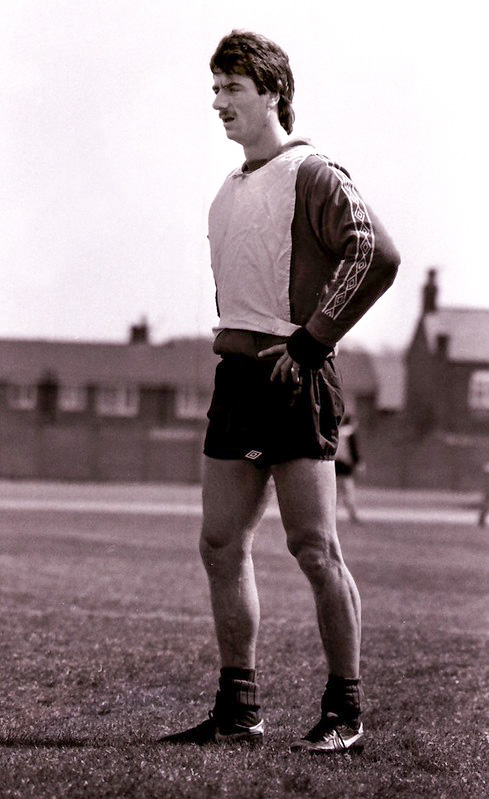
Rush at Melwood in 1984 - Image copyright - Skapti Hallgrímsson
When you went to Juventus in 1987 you were still living with your parents in Wales.
I married the week before I went to Italy and before that I lived with my parents. It was a complete reverse and it was just incredible. That's how you learn about how the world works.
Rush was supposed to join Juventus in the summer of 1986, but managed to get an extra year at the Reds. Juventus president, Giampiero Boniperti, said to Rushie's great surprise during contract negotiations that he was going to be loaned out for the 1986-87 season as Platini had decided to play one more season so Platini and Michael Laudrup were filling the two places allowed for foreigners at the Italian club.
Quote from Rush's autobiography, published in 2008:
"'OK if I have to go on loan, what about this,' I suggested. 'I sign for Juventus and I go back to Liverpool on loan for the season.'
"The lawyer raised his eyebrows, but I could tell by the slight sideways nod of his head he thought this a possible solution to the impasse. Peter Robinson practically grazed his jaw on his shirt buttons at the thought of Liverpool receiving over £3m, but still having me for another season."
Because of the limit of the foreign players there at Juventus I had to go to Lazio and there was no way I was going. I didn't want to play in Seria B. That helped me to get an extra year out of Liverpool.
Ian started his career in Italy brightly and scored 10 goals in 6 pre-season games. He scored 14 goals during the season of which 8 were in the league. To compare him with others, Diego Maradona was number one in the scoring charts with 14 league goals and Rush scored as many goals as Marco Van Basten at AC Milan and more than Rudi Voeller at AS Roma.
What do you make of your experience at Juventus?
We were spoilt at Liverpool. We win everything and when you leave you realise how lucky you are to be at Liverpool. Off the field I grew up as a person. I learnt a lot about the media. They were crazy over there. Footballer in Italy was like a a movie star and they would follow you everywhere.
Juventus owner Gianni Agnelli said that the club had complete faith in him after his debut season and asked Rushie what would be necessary to make him and the team a success and Rushie told him to get English players to compliment him.
AC Milan had the best team at the time with the three dutch lads and he asked me if I wanted any English players. I mentioned Steve McMahon, Graeme Sharp, Ray Houghton and Peter Beardsley. He went for Steve McMahon, Peter Beardsley and Ray Houghton and Kenny said no. I asked Kenny 'Why you didn't let them go to Juventus?' and Kenny said: 'If I'd done that you would still be at Juventus.' [smiles].
On 13th of August, one week before the English 1st division was to kick off, Paul Dean, Rushie's advisor phoned him and asked if he would like to return to Liverpool. 'Is the Pope's hat still over the top?', Rushie replied and that set the wheels in motion, Five days later Ian Rush was introduced to the press at Anfield as Liverpool's latest recruit.
It's incredible how they managed to keep your return to Liverpool a secret..
Kenny Dalglish was instrumental in making all that happen in 24 hours. That goes to show the relationship Liverpool Football Club had with Juventus because the whole deal was done over the phone. There had been rumours, but no one was sure and Kenny wouldn't tell them. He wouldn't tell them anything anyway [smiles]. It's only when I walked in at the press conference they realised I had come back to Liverpool.
Your famous quote that your time at Juventus "Was like playing in a foreign country" seems to have taken on a life of its own.
Kenny Dalglish was just joking when I came back to sign for Liverpool. Journalists were asking 'Why did you come back' and Kenny just started laughing and said because Rushie said 'That it was like playing in a foreign country.' Kenny was only joking and we were all laughing. Suddenly that quote came from me and all that exaggeration, but it's quotes like that people remember and I don't mind. I remember speaking to Jimmy Greaves about his famous "It's a funny old game." He never actually said that once. Sometimes it comes out like that and people remember you for that.
Souness was your manager at Liverpool for three years. What do you think about his legacy at the club?
He tried to change things too quickly, simple as that. There is no ifs and buts about it. If you speak to him now he knows it. He tried to get the young ones in there and the old ones out. When it wasn't happening he brought the old ones in and kicked the young ones out. He lost both the old ones and the young ones. He'd done it at Rangers, but the Scottish league is completely different to the English league. I always remember one of his first games vs Nottingham Forest. Brian Clough comes to Graeme and says, 'Welcome to the big leagues, son.'
Houllier recognised Rushie's coaching ability and added him to his staff to teach his strikers how to score goals in January 2003. Rushie has fond memories of Houllier.
Gerard Houllier is a fantastic coach and had really done well, but Liverpool were still not winning the league. Houllier changed Liverpool Football club into what it is today. Off the pitch he transformed Melwood into a European set-up. All the dressing rooms we've got at Melwood is largely down to Gerard Houllier. Every player that comes to Melwood realises it's a fantastic set-up and that's because of Gerard Houllier.
How does it feel like that every striker in Liverpool is compared to you? 'He's no Ian Rush' and so on and so forth. You are the benchmark for a goalscorer playing for Liverpool.
There are standards that you set. Liverpool Football Club are being blamed for not winning the title in 19 years and that's because of the high standards at Liverpool Football Club. If they win the league there will be someone who scores goals like me.
What is your opinion of Liverpool's current number nine, Fernando Torres?
He's a fantastic player. He's what Liverpool supporters wanted, like a breath of fresh air. His first season was incredible for the amount of goals he scored and it was great to see that. He had tough Euros with Spain and he's had his injury. Since he's come back from his injury he's like he was last year. I love people to compare him with me, that means he's scoring goals and that means they'll be winning league titles.
"I have played with and against some of the greatest strikers in the world during the past dozen years, and the greatest compliment I can pay Ian Rush is that he stands in comparison with the best, he's as good as any of them. Whatever that knack of scoring goals is, he has it. And that is something nobody can teach a footballer. Ian has also stayed totally unspoilt by his success. There is no edge to him, no question of him getting a big head." - Kenny Dalglish
Do you agree that your scoring record will never be beaten?
I don't think it will, simply because you have to be playing 14-15 years for one club which in the last 4-5 years is unheard of. Days of loyalty seem to have gone now. Maybe not from the players, but it's the football agents who have been moving in. You also have to be very lucky with injuries. I hadn't major injuries. These records, Ian Callaghan and my goalscoring one... in my lifetime I'll be surprised if they do get beat.
Copyright - Interview by Arnie and Harry for LFChistory.net