
In a 2023 internet article, Peter (‘redhel’) attempted to list all Football League games which had been abandoned. His motive for doing so was unclear, even to himself, but he was very specific about the difference between games which had been postponed, and those which had been abandoned. If one was cancelled before the referee had blown the first whistle, it was classed as ‘postponed’; if the match had kicked off, but was stopped later for whatever reason before the ninety allotted minutes were up, it was ‘abandoned’. It was the latter category which he was identifying, though that distinction has not always been evident in the general use of ‘abandoned’, which can often mean ‘postponed’. See e.g., the Liverpool Echo on 27 Dec 1924 explaining referee Kingscott’s late decision for the game against Aston Villa:
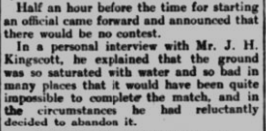
The match was therefore postponed, not abandoned.
The FA rules (E20) governing the consequences of the referee having to abandon a match depend on whether one club, or both, are judged to have been the cause of the problem. In either of such cases, the game would not be replayed. A replay would be ordered only if neither club is adjudged to have been the cause, in which case the League has the power to order the score, at the time the game was abandoned, to stand, and the gate receipts of the second match to go to the home club. If one club is deemed to have been responsible for the abandonment, the opponent would be given the points; if both are guilty, neither would receive points. Thus, Shankly’s joke about wanting two of his rivals to lose against each other was a possibility!
All the abandoned games in the article were listed in date order, with the total number for each club; in the case of Liverpool FC, he found seven since 1892. None of the seven (even Hillsborough) will be found in lfchistory.net because they were not completed, as only full matches are included. Everton does not appear in his list; nor do the great majority of the current Premier League clubs, though many subscribers have sent ‘redhel’ additions since. His seven Liverpool games (with Borussia M. a later addition) were:
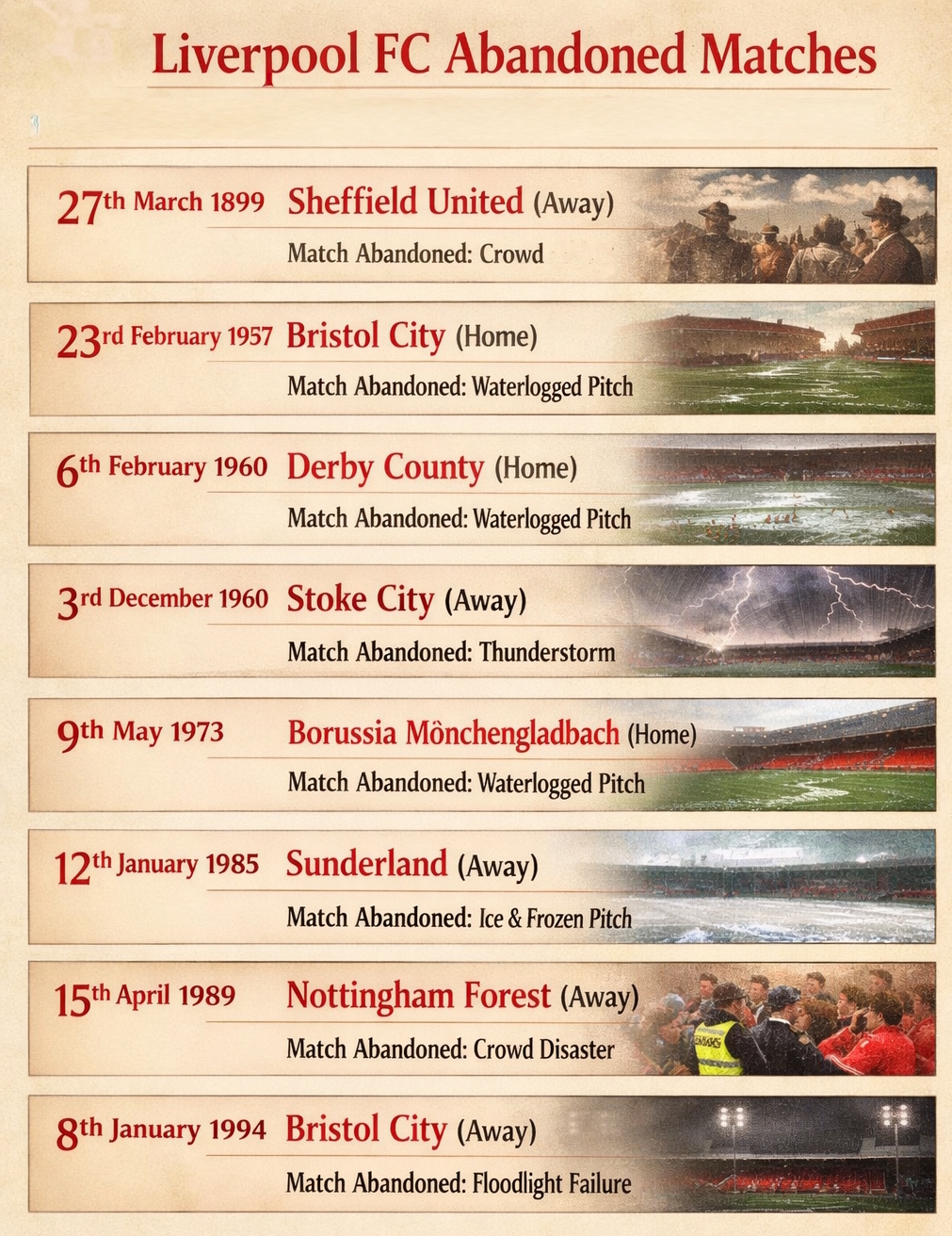
The inclusion of only one abandoned match before the second world war seemed very strange, especially in the days of far worse pitches and dirtier atmospheres. Overall, he found 90 abandoned games before World War 2, and 254 later (to 2023), so pre-war games were clearly underrepresented.
The following cases involving LFC have now been found during an investigation into pre-war fixtures, some being described as ‘abandoned’ but were really postponed.
(On a Monday) /12/1893 v Accrington (away, Lancashire League) Heavy storm, wind and rain
22/12/1894 v Derby County – ‘not commenced’ so postponed. (Cause not found, but there was a ‘severe gale’ at Wolverhampton, and a ‘boisterous wind in the extreme’ at Newark where Derby reserves were playing in an ‘absolute farce’.)
27/3/1899 v Sheffield United (away; FA Cup semi; see below); abandoned at half time.
10/2/1900 v West Bromwich Albion (home) sometimes called ‘abandoned’ e.g. in Athletic News and Liverpool Daily Post, but really postponed, through a heavy snowstorm.
14/1/1901 v West Bromwich Albion (away), thick fog, ground not opened, game postponed.
21/12/1901 v Bury (away) after 20 minutes. Thick fog, with Bury leading 2-0.
10/1/1903 v Sunderland (home), after 77 minutes, lack of light – error in starting time decision.
14/3/1903 v Wolves, (home) heavy rain
30/11/1907 v Bury, (away) fog after 25 minutes’ play
4/1/1908 v Manchester United, postponed a few minutes before kick-off, thick haze. Unusually for a postponed match, the players were listed in The Athletic:
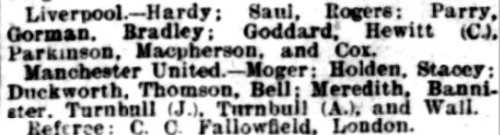
29/4/1911 v Chorley, (away) heavy rain after 25 minutes Lancs Combination match
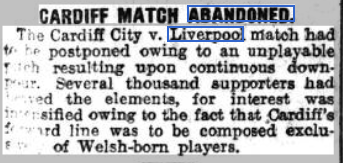
1/11/1924 v Cardiff, (away) heavy rain, pitch unplayable. Athletic News:
27/12/1924 v Aston Villa, postponed (see above, ground saturated by rain)
28/11/1925 v Aston Villa, postponed. (So much water on the pitch the ball floated.)
1/1/1931 v Bolton – called abandoned, but really postponed due to ice and thick fog.
25/12/1937 v Birmingham, (home), abandoned after about 5 minutes; thick fog. Echo:
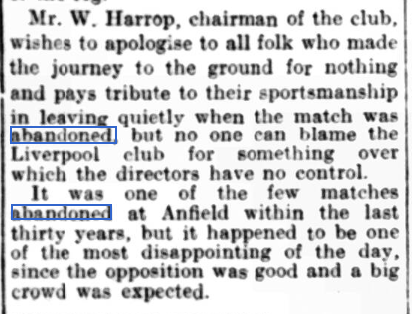
In reply to that last paragraph, an Everton supporter J. Sampson wrote in:
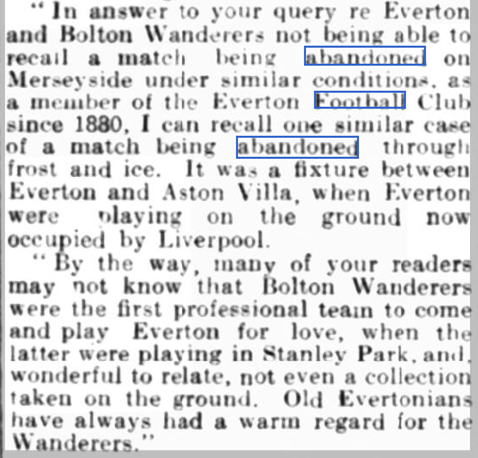
*
Among those listed, my attention was drawn to the coincidences of the anagrammed 1899 and 1989. Both fixtures involved the cities of Liverpool, Manchester, Nottingham, and Sheffield. Both were FA Cup semi-finals, and both were stopped early because of what happened in and to the crowd. Hillsborough in 1989 is only too well known, and whatever words are used to describe that tragic event seem quite inadequate to match the horror which still reverberates thirty-seven years later. The story of 27 March 1899 has been largely forgotten, but nevertheless worth retelling as there were features to the game which might entertain, if not inform. As in 1989, the game’s controlling authorities were rightly accused of bad planning, this time having had an earlier 1893 example which should have been a lesson.
Liverpool, under the guidance of Tom Watson, manager since 1896, was having an excellent season, one which would almost culminate in our first Division 1 title. To reach the semi-final, they had beaten Blackburn 2-0, Newcastle 3-1, and West Brom 2-0. In contrast, Sheffield United had needed a replay to get past Burnley in Round 1, another replay to defeat Preston North End in Round 2, and slipped past Nottingham Forest 1-0 to face Liverpool in the semi. Their league season ended on 16th place out of 18.
So, on paper, this should have been a walkover for Liverpool when they met at the neutral City Ground, Nottingham on 18 March, 1899 before 30,000 fans. It turned out to be what is still called ‘a real cup tie’, with a 2-2 draw an accurate reflection of the play, according to neutral reporters.
The replay was at Burnden Park, Bolton, five days later, with both defences at fault – always a promising basis for a high scoring match. In brief, Liverpool was winning 4-2 at the 84th minute when the sky fell in, with Sheffield’s outside-left Fred Priest scoring twice in a minute. (One report has inside-left Jack Almond scoring the second, but the Sheffield papers give both to Priest.)
We now move into the second replay, the venue being the fairly new (1892) Fallowfield Athletics Stadium, Manchester, also used as a velodrome, where the Everton v Wolves FA Cup Final had been held six years earlier. Its capacity was officially15,000, but on 25 March, 1893 the crowd was given as 45,000, the owners having assured the FA that it would comfortably hold 50,000. Contemporary estimates gave the crowd as up to 60,000, believed to be the largest crowd ever seen at a football match anywhere in the world at that time. The absence of high stands encouraged fans to move forward to get a better view (or any view at all), and several barriers were broken in ‘a scene of great disorder’ even before the start, according to the Birmingham Daily Post. The Sheffield Daily Telegraph headlined it as ‘A farce at Fallowfield’.
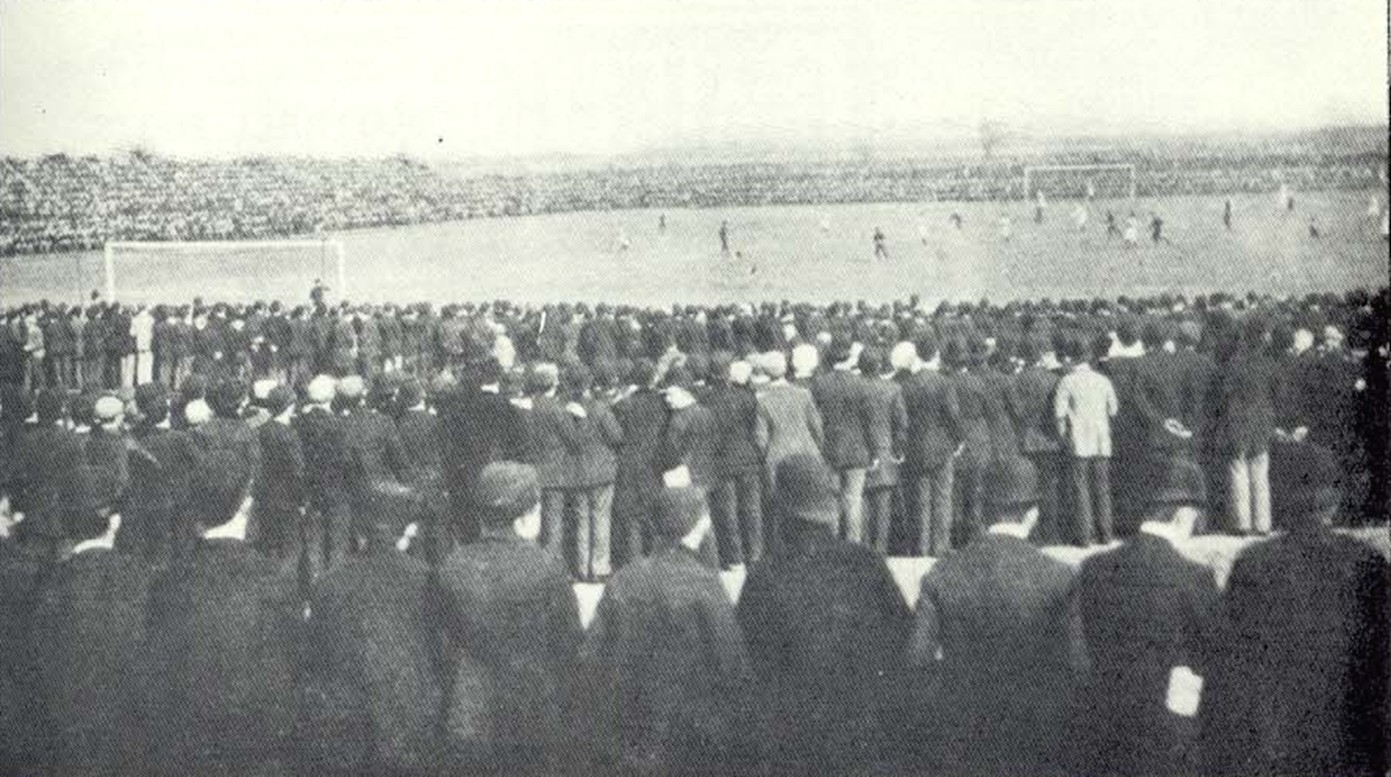
The 1893 Cup Final at Fallowfield, shot by an unknown photographer -via Wikipedia.
The outcome of that Everton game was a 1-0 loss to Wolves, the goal coming from one of many long balls played to ensure the frequent crowd encroachment onto to the pitch did not become entangled in the play. The crowd blocked the view from the specially-created press-box. Everton later complained that the ground was simply not fit for purpose, but unsuccessfully appealed to have the match replayed. Yet, here we were in Fallowfield, six years later, favourably positioned for good attendances from three major cities to create the same overcrowding problems as before.
For Liverpool’s opponents, travel details were given by the Independent:
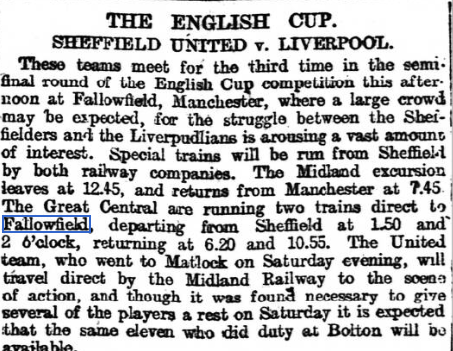
The majority of fans travelled from the city centre either on foot or on the tram, bus, or horse-drawn carriage.
The Liverpool Echo on 27 March 1899 pointed out that the Fallowfield ground had not yet proved to be an ‘ideal enclosure’, with sections unable to get a ‘fair view’ of the game. Scheduled to start at 4.00 p.m. in pouring rain, the crowd was estimated to be 25,000 by 3.30, and had burst through the barriers by 3.45 with the police quite unable to cope with the rush. In a delightful example of reporting which could not be found today, the Echo went on:
‘There was a large number of ladies present, and it was distressing to notice that in many cases where they had taken the trouble of obtain (sic) good position, they were swept away by the on rush of the sterner sex.’
For the match itself, we must turn to the Sheffield newspapers, as relatively little is available in the Liverpool press.
A sixth-minute goal by Liverpool’s Goldie was followed on the quarter hour mark by the overspilling crowd encroaching onto the edge of the pitch, and the referee (our friend Mr A G Kingscott again) stopped play to let the police clear the ground. A Sheffield goal was disallowed, which did little to improve relations between the fans. Towards the half hour mark, the Sheffield goalkeeper, rather unsportingly perhaps, complained that the spectators were interfering with play by their ‘unruly conduct’, and the game was halted again with the crowd encroaching ‘fully thirty feet’ onto the field, some erecting small stands (in front of the Press seats – shades of 1893!) to get a better view. Police (with reinforcements) and officials did their best to return the crowd at both ends to their rightful positions.
It took the authorities half an hour to restore order, and even then, the sun came out, the Liverpool team came out, but they had to wait another ten minutes before their Yorkshire opponents reappeared. So far, the game had been stopped for almost fifty minutes, and a rumour spread among the players that the match was going to be abandoned, with an inevitable effect on the quality of play. Darkness became an additional factor in the referee’s decision to abandon the game at half time, with Liverpool leading by the only goal.
It marked the end of the ground’s use as a major Association Football stadium, though the 1900 Rugby Challenge cup final was held there. After decades of use as an athletics stadium, famous cyclist Reg Harris owned it for a time, but it’s now underneath one of Manchester University’s Halls of Residence.
The third and last semi-final replay was fixed for the following Thursday (30 March) at the Baseball Gound in the referee’s home town of Derby, with instructions that the fixture must be concluded. It was a bad-tempered occasion, with some Liverpool players punished for refusing to give the referee the name of another perpetrator. Sheffield United won the match by the only goal, and indeed went on to beat Derby County in the FA cup final. It was their first FA Cup final win (as it had been for Wolves in 1893).
*
Where ‘redhel’ had seven Liverpool games in his original list, Arsenal, Manchester City, Plymouth and West Bromwich were all into double figures. Liverpool comes out of this survey very well, with only 6 games having been abandoned at Anfield since 1892.
Copyright - Dr Colin D. Rogers for LFChistory.net
Screenshots of press articles from the British Newspaper Archive