
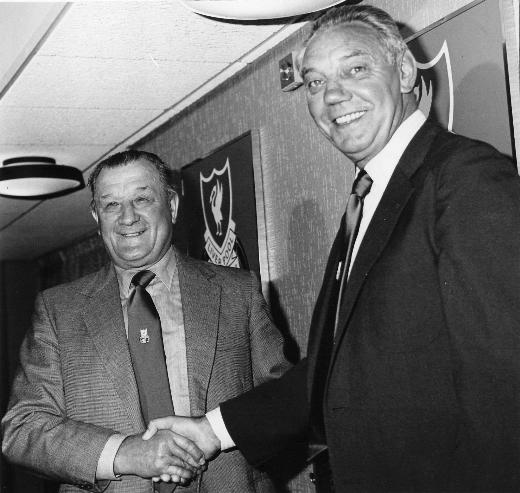
At the age of 62, Joe Fagan had finally become manager of Liverpool FC. This unassuming family man, who still lived in a modest semi detached house a few hundred yards from the ground, had risen from assistant coach to manager in a glorious upward path stretching back a quarter of a century. The difference in the club circa 1983 from the Second Division outfit he had joined in 1958 was there for all to see. Joe's job now was ensuring the club maintained it's position amongst Europe's elite.
As Bob Paisley had been before him, Joe Fagan was not exactly bursting at the chance to take on the managers role. In a remarkably self effacing quote he revealed, "I took the job because I was in a rut when they offered it to me. Ronnie Moran and Roy Evans were doing the training and I was just helping Bob, putting in my two pennyworth."
Whilst dominance of the domestic scene was paramount, European dominance had always been the ultimate goal of the Boot Room boys. After Bob Paisley had secured the first European Cup in 1977 he had gone on to cement Liverpool's stake in the European hall of fame with further triumphs in '78 and '81, but as in '79 and '80 (when Nottingham Forest had emerged briefly as the new European force) the club had once again gone two years without claiming the trophy. It was time to reassert the club presence at the highest level.
Ronnie Moran was promoted to work as Fagan's assistant and the 1983-84 season started as so many of the previous seasons had started, with a Charity Shield date at Wembley. Manchester United comfortably ran out 2-0 winners in a low key affair and typically Joe Fagan hid from no one in his after match analysis telling the assembled press, "Blame me. It was my fault. I put the substitutes on at the wrong time. You learn something all the time in this game."
But it was at Molyneux a week later, where the league campaign would get underway against Wolves, that all eyes were really focused. A 1-1 draw meant that Liverpool had gone an incredible nine games without victory (the last seven of Paisley's reign had seen five defeats and two draws as the team wound down after winning the championship early), a statistical quirk that remained the worst run of the Boot Room era.
The team promptly won five of their next six games and the die was cast. The settling in period had been tough initially, but as Joe explained, it was all about handling expectations, "The first couple of weeks were a bit rough because my mind was racing everywhere, yet I seemed to be doing nothing," he said. "I was frightened to death I would end up like Bob after his first season in charge, without a trophy."
He needn't have any fears on that score as the league title was won for a third consecutive time, the first time Liverpool had ever achieved the feat. Ian Rush, the man who had emerged from the shadows to become the club's most prolific scorer since the days of Roger Hunt, finished the season with 32 league goals - the first Liverpool player to top 30 league goals since Hunt himself in 1965-66. His haul included five against Luton in October, four against Coventry in May and a hat trick at Villa Park in January and he was to finish the season with an overall total of 47.
Disappointment in the FA Cup (a 4th round exit at the hands of Brighton), was to be the only other negative aspect of the season. A fourth consecutive League Cup tophy was secured with an historic victory over neighbours Everton. It was the first time the clubs had ever met in the final of a major competition and Liverpool secured a 1-0 victory in a Manchester replay at Maine Road after the first game at Wembley finished in a 0-0 stalemate. A tortuous trek through the earlier rounds, where the Reds were forced into replay after replay, saw them play an incredible 13 games on route to success.
In Europe things were no less dramatic with Liverpool three times having to play second leg games away from home on the knife edge of a slender first leg lead or on level terms. The first round was routine enough - a 6-0 aggregate score over Danish side BK Odense but the second round draw was less kind.
Spaniards Atletico Bilbao came to Anfield and prised away a first leg 0-0 draw. A solitary Ian Rush goal in Bilbao saw the Reds through to a spring encounter with Benfica whereupon another Rush goal, this time at Anfield, gave the Reds a 1-0 advantage over the Portuguese going into the second leg. On a dramatic night in the Stadium of Light two weeks later, a virtuoso Liverpool rolled Benfica over with a comprehensive 4-1 demolition.
.JPG)
The semi-finals brought Iron Curtain opposition in the shape of Dynamo Bucharest and again Liverpool struggled to make an impression at Anfield in the first leg. A lone Sammy Lee strike was all they could manage against tough, physical opponents. In Bucharest however, the team were able to play with more freedom and two more Rush goals helped to secure a 2-1 victory for a 3-1 aggregate score.
By this time, the first leg of an improbable treble had been completed with that League Cup success over Everton and now the second leg was in sight as Liverpool closed in on the league title. A point at Notts County on May 12th took care of that, and incredibly in his first season in charge, Joe Fagan found his side on the brink of a treble never before won in the English game.
But perhaps the most difficult tie of all awaited the Reds in the final of the European Cup. Opponents AS Roma would be playing the game on their home ground, the venue having been decided months in advance by UEFA. Liverpool, however, had the psychological fillip of having won the European Cup in Rome's Olympic Stadium some seven years earlier and that advantage was to prove decisive.
Phil Neal, a scorer in that game seven years earlier, put the Reds 1-0 up in the first half only for Pruzzo to equalise in the second half. The game finished in stalemate and went to a penalty shoot out in which Liverpool out-psyched their Italian opponents 4-2. The treble was won.
Joe Fagan joined the pantheon of greats that night.
Liverpool Grobbelaar, Neal, Kennedy, Lawrenson, Whelan, Hansen, Dalglish (Robinson), Lee, Rush, Johnston (Nicol), Souness
AS Roma Tancredi, Nappi, Bonetti, Righetti, Nela, Falcao, Di Bartolomei, Cerezo (Strukelj), Conti, Pruzzo (Chierico), Graziani.
 The glories of season '83-'84 were a long way from the gloom and tragedy that was to follow. Season '84-'85 got underway with new signings Paul Walsh and Jan Molby hoping to make great impressions and they made their bows in the Charity Shield curtain raiser at Wembley. Everton exacted a measure of revenge for their League Cup defeat some months earlier by taking the Shield 1-0. Based on the previous season, a good omen perhaps? No was the answer.
Inexplicably, Everton were flying. After an atrocious period under manager Howard Kendall the team had been transformed by the previous season's cup runs (they'd also reached the '84 FA Cup final and won it) and they romped to the league title with a massive thirteen point margin doing a league double over the Reds along the way.
The grasp on the League Cup was finally loosened by a Spurs side who delivered Liverpool's first knock out in the competition for five years with a 1-0 victory at White Hart Lane.
Liverpool fared better in the FA Cup reaching the semi finals only for a Ron Atkinson led Manchester United to put them out in a Maine Road replay. All hopes of silverware rested on the European Cup, a trophy that had started to feel like private property.
The Reds marched impressively into the semi finals after despatching Lech Poznan, Benfica (again), and Austria Vienna in the earlier rounds. The only real wobble had been a 1-0 reverse in the first leg in Austria, a reverse that was crushingly overturned 4-1 at Anfield. New signing Walsh had weighed in with a couple of important goals but it was John Wark who had taken the mantle of leading scorer, Ian Rush having spent a lot of the season sidelined with a cartilage injury.
The Greeks of Panathinaikos provided the opposition in the semi finals and Liverpool ran out 4-0 winners in the first leg at Anfield to put the tie beyond doubt. A comfortable 1-0 win in Greece tied up the loose ends and Liverpool were into their fifth European Cup final in nine attempts.
The Italians of Juventus, who had defeated Liverpool in that season's European Super Cup, were to be the opponents in Belgium's Heysel Stadium, Brussels. Juve boasted the talents of Frenchman Michel Platini and Pole Zbigniew Boniek and would be no pushovers.
In the event, the match on May 29th 1985 carried little relevance. For the record, Juventus won 1-0 with a disputed Platini penalty but none of that mattered. The trouble that erupted before the game and brought the deaths of 39 Juventus supporters was to bring a dark shadow down on the career of the man who had been instrumental in starting the whole Boot Room revolution.
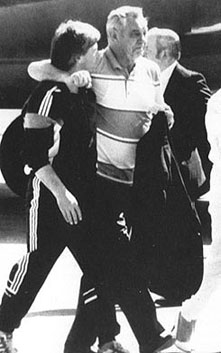
Unfortunately it was a shadow Fagan was never able to disassociate himself from. As he was helped across the tarmac of Liverpool's Speke airport the following day by his great friend Roy Evans, he cut the figure of a disconsolate and broken man. It was a desperately sad end to a glorious career.