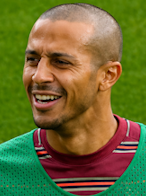
Thiago Alcantara arrived at Liverpool with a reputation as one of European football’s most accomplished midfielders. His close control, awareness and range of passing offered Jürgen Klopp another way to dictate matches, particularly against opponents who defended deep and restricted space. He could receive the ball in crowded areas, escape pressure with a turn or a disguised touch, and change the direction of an attack before opponents had time to reorganise. His contribution also extended beyond possession: anticipation and an eagerness to regain the ball made him more than simply a gifted playmaker. Klopp had admired him long before bringing him to Anfield. When Liverpool agreed to sign Naby Keita in 2017, the manager explained: “I’ve got lots of contacts in Germany and I’ve never got so many congratulations messages after we signed him. He is the best player in the league. Last year together with Thiago Alcantara they were the best in the league.” Three years later, Liverpool’s manager had the opportunity to select both players in the same midfield.
Thiago’s footballing education had crossed several countries. Born in Italy while his father, Mazinho, was playing there, he came from a Brazilian family but developed into a Spain international. Mazinho was a member of Brazil’s 1994 World Cup-winning team, while Thiago’s younger brother, Rafinha, also became a professional footballer and represented Brazil. Thiago followed a different international path after developing in Spain and progressing through Barcelona’s La Masia academy. He eventually earned 46 senior caps for Spain, scoring twice. His talent was particularly evident in Spain’s successful youth teams. He helped them win the European Under-21 Championship in 2011 and captained the side that retained the trophy two years later. In the 2013 final against Italy, he scored a first-half hat-trick in a 4–2 victory and was named Player of the Tournament. It was an emphatic demonstration of his ability to combine control of a match with decisive contributions near goal.
At Barcelona, Thiago’s emergence coincided with an exceptional generation of midfielders, making regular selection difficult despite his obvious promise. Pep Guardiola recognised his potential and made him a priority after taking charge of Bayern Munich in 2013. “I spoke to the club and told them about my concept and told them why I want Thiago,” Guardiola explained. “He is the only player that I want. It will be him or no one.” The move to Germany gave Thiago the opportunity to establish himself as a central figure in another outstanding team. He won the Bundesliga in each of his seven seasons at Bayern, adding four German Cups and the Champions League among numerous honours. He made 235 competitive appearances and scored 31 goals for the club. His final appearance brought the greatest prize in European club football, as Bayern defeated Paris Saint-Germain 1–0 in Lisbon on 23 August 2020 to complete a league, cup and Champions League treble. Bayern coach Hansi Flick’s farewell reflected the affection in which Thiago was held as well as his footballing importance. “It was very emotional as we said goodbye,” he said. “I can only congratulate Liverpool as they got a great player and especially a great person. Thiago gave the team a lot of options and made us unpredictable, he solved things in ways you don’t expect.”
Liverpool confirmed his signing on 18 September 2020, bringing an established international into a squad that had just won the Premier League. Two days later, he made his debut at Chelsea, replacing the injured Jordan Henderson at half-time. Against opponents reduced to ten men, Thiago immediately demonstrated his assurance in possession as Liverpool won 2–0. He completed 75 passes, the highest total recorded in a Premier League match by a player appearing for 45 minutes or fewer since comprehensive passing records began in 2003/04.
That encouraging introduction was followed by an unfortunate interruption. Thiago tested positive for COVID-19 and missed Liverpool’s next fixtures before making his first start in the Merseyside derby at Goodison Park on 17 October. He impressed in the 2–2 draw but suffered a knee injury following a late challenge by Richarlison, who was sent off. Thiago completed the match, yet the consequences kept him out until the end of December. His first months in England had therefore brought only two appearances and little opportunity to establish a rhythm with his new teammates. He returned as a substitute in the goalless draw at Newcastle United on 30 December, but rejoined a team whose season was becoming increasingly difficult. Injuries had devastated Liverpool’s central defence, and the need to use midfielders further back disrupted the balance of the side. Thiago was adapting to English football during a period when the team around him was also being repeatedly reorganised. The largely empty stadiums of the pandemic season added another unusual element to his introduction to Liverpool. As the campaign progressed, his influence became clearer. Liverpool finished with ten unbeaten league matches to recover a place in the Champions League, and Thiago’s passing helped give their midfield greater control during that revival. His first Liverpool goal arrived against Southampton at Anfield on 8 May 2021, when a precise finish from the edge of the penalty area secured a 2–0 victory. After such a disrupted beginning, he ended the season with a more convincing demonstration of what he could offer.
The 2021/22 campaign provided the fullest expression of his quality at Liverpool. Thiago made 39 appearances in all competitions, with his partnership alongside Fabinho giving Klopp a combination of defensive protection and imagination in possession. His ability to draw opponents towards him before releasing the ball helped create space for teammates, while his willingness to attempt difficult passes allowed Liverpool to penetrate organised defences. On 24 November 2021, he scored one of the most memorable goals of Klopp’s reign against Porto at Anfield. Meeting a clearance around 25 yards from goal, Thiago struck a first-time half-volley that travelled just above the grass and into the bottom corner. The precision of the contact and the unusually low flight of the ball made it a remarkable piece of technique. Liverpool won 2–0, and supporters later voted the strike the Champions League Goal of the Tournament.
Thiago's performances during the spring were equally striking. In the 4–0 victory over Manchester United at Anfield on 19 April, he repeatedly escaped pressure and controlled the direction and tempo of Liverpool’s attacks. He completed 108 passes and created three chances, but the figures only partly conveyed the ease with which he manipulated the ball and the opposition midfield. Eight days later, UEFA named him Player of the Match in Liverpool’s 2–0 Champions League semi-final first-leg victory over Villarreal. These were performances that showed how influential he could be when fitness and continuity allowed him to operate at his best. There was personal heartbreak amid Liverpool’s pursuit of four trophies. Thiago had been selected to start the League Cup final against Chelsea in February but suffered an injury during the warm-up and had to withdraw. His tears on the bench revealed how much the occasion meant to him after the difficulties of his first season. He was able to participate fully when the clubs met again in the FA Cup final on 14 May. Thiago played all 120 minutes of the goalless draw and converted Liverpool’s second penalty in the shoot-out, sending his kick down the middle. Liverpool won 6–5 to complete a domestic cup double. His performances throughout the league campaign also earned him selection in the PFA Premier League Team of the Year.
Liverpool’s hopes of adding the Premier League and Champions League ultimately ended in disappointment. They finished one point behind Manchester City and lost the European final 1–0 to Real Madrid in Paris. Nevertheless, Thiago had established himself as an important member of a team that competed for every major honour until the closing days of the season. Unfortunately, that level of involvement could not be sustained. Thiago made 28 appearances in 2022/23, with hamstring and hip problems repeatedly interrupting his campaign. Liverpool’s midfield struggled for consistency, and his absences removed a player capable of bringing composure to difficult passages of play. He underwent surgery on his hip before the season ended, with the hope that treatment would allow him to return for the following campaign. Instead, 2023/24 became an almost complete lost season. Thiago remained unavailable throughout its first half and finally returned for a brief substitute appearance in the 3–1 defeat at Arsenal on 4 February 2024. A subsequent muscle injury prevented him from playing again. That short outing proved to be his final competitive appearance, leaving him with 98 Liverpool matches and three goals across four seasons. His contract expired in June 2024, and the following month he announced his retirement at the age of 33. Liverpool supporters had seen enough to appreciate his exceptional ability, particularly during the pursuit of four trophies in 2021/22, but injuries denied him the sustained influence his talent promised. His Liverpool career contained both outstanding performances and long periods in which the team had to manage without him.
Retirement soon opened a route into coaching. In July 2024, Thiago returned to Barcelona for a short spell working with Flick’s staff, gaining experience of a different side of the game. The association became a formal appointment on 11 September 2025, when Barcelona confirmed him as an assistant coach. His responsibilities included tactical work and the preparation of training sessions, allowing him to apply the understanding of space, movement and possession that had distinguished his playing career.