
Jim Harley
Defender · Liverpool 1934–1948
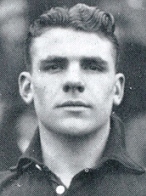
Personal
- Born
- 21 February 1917
- Place of birth
- Methil, Fife, Scotland
- Died
- 1989
- Other clubs
- Rosslyn Juniors (1933-34), Hearts Of Beath (1933-34)
At Liverpool
- Signed from
- Hearts Of Beath
- Joined
- 30 April 1934
- Debut
- 28 September 1935
- Last appearance
- 17 April 1948
- Contract expiry
- 1948
Liverpool career
- League 115 apps · 0 goals
- Win ratio 38.17% — W 50 · D 33 · L 48
- Wartime 62 apps · 3 goals
- Assists not recorded before 1945–46
Honours
- League Championship
- 1946-47
Player profile
Scotsman "Big Jim" Harley was one of the toughest customers who have played for Liverpool Football Club. He combined the strength of a formidable full-back with the speed of a prize-winning sprinter. Harley joined Liverpool from Hearts of Beath in April 1934, aged only 17. A natural left-back who could also play on the right, he initially developed in the reserves before making his senior debut at right-back in a 5–0 victory over West Bromwich Albion at Anfield on 28 September 1935. Harley’s athletic ability brought him success beyond football. In January 1936, while still only 18, he won Edinburgh’s prestigious Powderhall 130-yard sprint handicap under the pseudonym "J H Mitchell". The contemporary report identified the winner as Liverpool’s reserve left-back and a former chalk-pit worker, standing six feet tall and weighing more than fourteen stone. Despite his substantial build, he beat D. Boyle of Broxburn by half a yard to collect £100 and a gold medal. His interest in sprinting continued after that triumph, with newspaper reports recording further Powderhall entries under his racing name in 1939 and 1943.
First-team opportunities were initially limited. Harley made eight league appearances in 1935/36 and five the following season, when he also played once in the FA Cup. His breakthrough came in 1937/38, with 33 league appearances and five in the cup, followed by another 34 competitive outings in 1938/39. His pace and physical strength made him a difficult opponent for wingers, while his ability to operate on either side of the defence increased his value to Liverpool. The Liverpool Echo wrote: "Besides a Charles Buchan chest and shoulders he had the strong, but slim undercarriage of the sprinter. Woe betide the speeding winger who thought he could make a race of it and take the ball, Harley took both." Harley also played in all three league fixtures at the beginning of 1939/40, but those results were expunged when the competition was abandoned following the outbreak of war. At 22, just as he had established himself, his league career was interrupted for seven years.
Harley joined the Royal Navy after war broke out and took part in the evacuation of Dunkirk. His own account, published in the Evening Express on 25 June 1940, described seven trips aboard a vessel subjected to repeated attacks. “We made seven trips and practically all the time we were bombed from the air and shot at,” he recalled. Harley said the men had managed about two hours’ sleep in a week and had given much of their food to the exhausted soldiers they brought aboard. He was also one of two naval men who brought a boat carrying wounded troops back to the ship under machine-gun fire, taking an hour and a half to cover just 400 yards. His wartime service also included the Dieppe raid in August 1942. Shortly afterwards, the Evening Express reported that he was going to Scotland on leave to visit his wife and relatives, and that Liverpool had given him permission to play for East Fife. Football remained part of his life whenever service commitments allowed, although his availability was necessarily irregular.
War football even gave Harley an unexpected opportunity to demonstrate his attacking ability. On 9 October 1943, George Kay surprised his players by selecting the full-back at outside-right against Everton at Goodison Park. Harley rewarded the decision with a goal in Liverpool’s 6–4 victory. He remained on the wing for the return meeting the following week and scored again, opening Liverpool’s account in a 5–2 win. The experiment was successful enough for the Evening Express to recall it in February 1945 when Liverpool were again considering him for a forward role against their neighbours. Harley also represented Scotland in two wartime internationals against England in 1945, playing at Villa Park on 3 February and Hampden Park on 14 April. Liverpool colleague Matt Busby captained Scotland in both matches. These fixtures did not count as official full internationals, but they nevertheless gave Harley the opportunity to represent his country against England.
When the Football League resumed in 1946, Harley returned to a Liverpool side that would win the First Division championship. He contributed 17 league appearances to the 1946/47 triumph, securing a major honour after so much of his playing career had been lost to war. Having turned 30 during that season, he made another 21 league appearances in 1947/48 before leaving when his contract expired. His final competitive appearance came on 17 April 1948. Harley finished with 131 official Liverpool appearances, comprising 115 in the league and 16 in the FA Cup, without scoring. His goals in wartime football, including those memorable strikes against Everton, belong to a separate record of a career shaped as much by naval service as by life at Anfield.
Former Reds goalkeeper Charlie Ashcroft told historian Gary Shaw that Harley was one of a kind. “Charlie revealed that Harley would often come into training covered in cuts and bruises on his face and knuckles," Gary said. "He’d been out fighting the night before but not just with one man. That was a waste of time for Harley who’d prefer to take on two, three or even four at a time. He got arrested for brawling on a number of occasions, which the club took steps to cover up. Apparently there were few harder than Harley. He was fearless.”
Appearances per season
| Season | League | FA | LC | Europe | Other | Total |
|---|---|---|---|---|---|---|
| 1935-1936 | 8 | 0 | 0 | 0 | 0 | 8 |
| 1936-1937 | 5 | 1 | 0 | 0 | 0 | 6 |
| 1937-1938 | 33 | 5 | 0 | 0 | 0 | 38 |
| 1938-1939 | 31 | 3 | 0 | 0 | 0 | 34 |
| 1939-1940 | 0 | 0 | 0 | 0 | 0 | 0 |
| 1945-1946 | 0 | 3 | 0 | 0 | 0 | 3 |
| 1946-1947 | 17 | 4 | 0 | 0 | 0 | 21 |
| 1947-1948 | 21 | 0 | 0 | 0 | 0 | 21 |
| Totals | 115 | 16 | 0 | 0 | 0 | 131 |
A more detailed look at the player's appearances
| Apps | Mins | Opponent |
|---|---|---|
| 131 | 11,850 | All opponents |
| 8 | 720 | Sunderland |
| 7 | 630 | Arsenal |
| 7 | 630 | Derby County |
| 7 | 630 | Portsmouth |
| 7 | 630 | Preston North End |
| 7 | 630 | Wolves |
| 6 | 540 | Chelsea |
| 6 | 540 | Huddersfield Town |
| 5 | 450 | Birmingham City |
| 5 | 450 | Blackpool |
| 5 | 450 | Bolton Wanderers |
| 5 | 450 | Charlton Athletic |
| 5 | 450 | Grimsby Town |
| 5 | 450 | West Bromwich Albion |
| 4 | 360 | Aston Villa |
| 4 | 360 | Leicester City |
| 4 | 360 | Manchester City |
| 4 | 360 | Sheffield United |
| 4 | 360 | Stoke City |
| 3 | 270 | Blackburn Rovers |
| 3 | 270 | Brentford |
| 3 | 270 | Everton |
| 3 | 270 | Manchester United |
| 3 | 270 | Middlesbrough |
| 2 | 210 | Burnley |
| 2 | 180 | Chester City |
| 2 | 210 | Crystal Palace |
| 2 | 180 | Leeds United |
| 1 | 90 | Luton Town |
| 1 | 90 | Norwich City |
| 1 | 90 | Stockport County |
| Total | Venue |
|---|---|
| 67 | Home |
| 62 | Away |
| 2 | Neutral |
| Total | W | D | L | Win% | Manager |
|---|---|---|---|---|---|
| 123 | 48 | 32 | 43 | 39.0% | George Kay |
| 8 | 2 | 1 | 5 | 25.0% | George Patterson (2nd term) |
Wartime Appearances / Goals
| Season | Appearances | Goals |
|---|---|---|
| 1939-1940 | 6 | 0 |
| 1940-1941 | 6 | 0 |
| 1941-1942 | 4 | 0 |
| 1942-1943 | 2 | 1 |
| 1943-1944 | 3 | 2 |
| 1944-1945 | 16 | 0 |
| 1945-1946 | 25 | 0 |
| Totals | 62 | 3 |
Related Articles
The rabbit’s foot runs out of luck
A press report relating to Wolves - Liverpool on 11.02.1939.