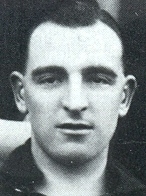
"A slip of a lad he was not entirely a one-footed player but it was that left boot which put fear into the hearts of goalkeepers when they saw Alf prancing down the wing," wrote the Liverpool Echo. Hanson combined the pace and crossing expected of an outside-left with a scoring record that many inside-forwards would have envied. His powerful left foot made him a threat when cutting towards goal as well as when supplying Liverpool’s central attackers. Although his Anfield career brought no major honours, his 52 goals in 177 competitive appearances made him a significant contributor during an unsettled period in the club’s history. Fifty of those goals came in 166 First Division matches.
A Bootle lad with Norwegian family connections, Hanson later explained that his original surname was Hansen and that his father had been a Norwegian mariner. Newspapers nevertheless consistently knew him as Hanson. His route into senior football included appearances for Everton’s A-team and reserves, followed by amateur football with Runcorn and Bedford. He appeared in Liverpool’s reserve side during 1931/32, but had to wait until 21 January 1933 to make his first-team debut, in a 5–2 defeat at Aston Villa. His first goal followed in his second appearance, against Middlesbrough at Anfield on 1 February, although Liverpool again lost, this time 3–1. Hanson's fourth appearance provided a much happier introduction to life at Anfield. On 11 February 1933, he scored against his former club Everton in Liverpool’s remarkable 7–4 derby victory. It was only his second Liverpool goal, but already he had contributed to one of the most memorable matches in the club’s history. He finished that introductory campaign with two goals in eleven league appearances before establishing himself more firmly the following season.
Hanson scored thirteen times in 39 league and cup appearances during 1933/34. One particularly valuable goal came in the FA Cup replay at Fulham on 17 January 1934. With Liverpool trailing 2–0, he took advantage of uncertainty between the home defenders and goalkeeper to pull a goal back. Tom Bradshaw’s late equaliser forced extra time, before Syd Roberts completed the recovery with the winner. Hanson’s intervention had begun the turnaround in a tie Liverpool appeared to be losing. After another productive season, injury restricted him to just five appearances in 1935/36. His response was emphatic: he played all 42 league matches the following campaign and scored thirteen goals, helping Liverpool retain their First Division place as they finished eighteenth. In 1937/38 he improved his return to fifteen goals in all competitions, fourteen of them in the league. His final two seasons therefore produced 28 goals, demonstrating that his earlier injury problems had not diminished his effectiveness.
Chelsea secured Hanson in July 1938 for £7,500, a record fee received by Liverpool at the time. His Chelsea debut brought him straight back to Anfield on 27 August, when Liverpool won 2–1. Chelsea’s historical appearance archive credits him with 43 official league and FA Cup appearances and nine goals in 1938/39. The outbreak of war then interrupted his Football League career while he was still in his twenties. Hanson continued playing during the war, representing several clubs as a guest and returning to Liverpool for sixteen wartime appearances where he did his best to hide his christian name, Adolph! Hanson played for England against Scotland on 8 February 1941, a wartime international which Scotland won 3–2. Another return to Merseyside ended painfully on 2 June that year: playing for Liverpool at Goodison Park, his low cross forced an own goal from Tommy Jones, but he later suffered a dislocation of his left knee and was taken to Walton Hospital.
His career still had a rewarding post-war chapter. By October 1946 he was playing inside-forward for Shelbourne, with contemporary reports praising his performances in Dublin. He finished the 1946/47 League of Ireland season as joint leading scorer with eleven goals. Hanson featured in the Welsh league, joining Penmaenmawr in November 1950 Hanson also undertook player-manager roles with South Liverpool and Ellesmere Port Town, extending his involvement in football beyond his years at Anfield and Stamford Bridge.