
Billy Dunlop
Defender · Liverpool 1894–1909
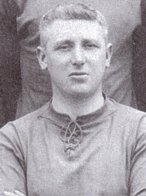
Personal
- Born
- 11 August 1874
- Place of birth
- Hurlford, Scotland
- Died
- 28 November 1941
- International
- 1/0 Debut 07.04.1906 vs. England
- Other clubs
- Hurlford, Kilmarnock, Abercorn (1893-95)
At Liverpool
- Signed from
- Abercorn
- Joined
- 11 October 1894
- Transfer fee
- £35
- Debut
- 25 March 1895
- First goal
- 16 February 1898
- Last goal
- 11 March 1905
- Last appearance
- 17 April 1909
- Contract expiry
- January 1910
Liverpool career
- League 325 apps · 2 goals
- Win ratio 47.93% — W 174 · D 69 · L 120
- Assists not recorded before 1945–46
Honours
Player profile
Scottish-born left-back Billy Dunlop was one of the most enduring figures of Liverpool's formative years, serving the club for more than 15 years after arriving from Paisley Abercorn in October 1894. A profile published in the London Football Evening News on 21 December 1895 offered an encouraging early assessment of Liverpool's new signing. The newspaper praised his clean kicking, confident tackling and ability to make life difficult for opposing forwards. At 5ft 9in and weighing approximately 11st 9lb, he was considered a particularly useful acquisition for the Anfield club. Dunlop made his Liverpool debut against Bury on 25 March 1895, towards the end of a disappointing season in which the club suffered relegation to the Second Division. He became a regular the following campaign as Liverpool immediately bounced back, winning the Second Division championship and securing promotion. However, an ankle injury interrupted his progress during 1896/97. Tom Wilkie and Archie Goldie formed an effective defensive partnership in his absence, leaving Dunlop with a battle to regain his place. He eventually displaced Wilkie for the final seven matches of the season, beginning a lengthy spell as Liverpool's established left-back.
Dunlop's defensive qualities attracted considerable attention. In an assessment published by the Lancashire Evening Post on 2 September 1899, the newspaper's football correspondent described a player whose physical strength, speed and agility were complemented by a cool head and sound judgement. He was particularly admired for remaining composed under pressure and dealing confidently with individual opponents as well as entire attacking formations. Dunlop's consistency was equally impressive. He played 33 of Liverpool's 34 league matches in 1898/99 and appeared in every league fixture the following season. He missed only one match in 1900/01 and another in 1901/02. Consequently, he featured in 133 of a possible 136 league games across those four campaigns, a remarkable record for a defender in an era of physically demanding football.
Dunlop's reliability and standing within the dressing room were recognised when he was appointed Liverpool captain for the 1899/1900 season. He subsequently became Alex Raisbeck's vice-captain, continuing to provide leadership as the club developed into one of the leading sides in English football. Dunlop was a prominent member of the team that secured Liverpool's first-ever First Division championship in 1900/01. The achievement was particularly significant after the club's earlier struggles and demonstrated how far Liverpool had progressed since their formation less than a decade earlier. He remained a key member of the side during the following seasons, including the difficult 1903/04 campaign, when Liverpool were relegated once again. He helped the club recover immediately, as Tom Watson's side won the Second Division championship in 1904/05 to return to the top flight.
A particularly revealing portrait of Dunlop appeared in the joint Everton and Liverpool match programme on 17 September 1904: According to Liverpool's match programme from 17 September 1904: "Dunlop plays a characteristic full-back game, and the familiar cry of on the Anfield ground 'Boot it, Dunlop' is fairly suggestive of his method of defence. There can be no two opinions of his ability to kick the ball from almost any position. Always keen and watchful on the field, he betrays his over-anxiety to repel the invader by his terrific lunges, and on his day, there is no more brilliant player than this same Dunlop. A better servant no club ever possessed, and though we may occasionally differ from him as to the methods he employs on the field, on one point we must all agree, that for downright single-mindedness of purpose Dunlop's tactics have never been questioned." The same profile offered fascinating details about his life away from football. Dunlop was the third of seven brothers, although he was the only one to pursue football seriously. Several of his brothers were accomplished musicians, and he himself was a talented violinist.
The Scotsman's reputation extended beyond Anfield. Despite having previously been overlooked for Scotland selection following impressive performances in representative football, Dunlop finally received international recognition in April 1906. He made his only appearance for Scotland against England at Hampden Park on 7 April, playing alongside Liverpool captain Alex Raisbeck in a 2–1 victory for the Scots. The recognition was a fitting reward for a player whose consistency had been evident for many years. Liverpool's second First Division championship followed in 1905/06, with Dunlop again playing an important role in the successful side. He also helped the club win the Sheriff of London Charity Shield in 1906, as well as two consecutive Liverpool Senior Cup competitions in 1905 and 1906. By April 1906, the Liverpool Football Echo was particularly complimentary about his professional conduct. It highlighted his exceptional discipline, explaining that he was renowned for looking after himself and had never caused difficulties for either his teammates or the club's trainer. His wholehearted commitment to Liverpool was beyond question, while his long clearances remained an important defensive weapon. The newspaper referred to him as the club's sub-captain and anticipated that supporters would enthusiastically contribute to his forthcoming benefit.
Dunlop's influence gradually diminished as the years passed, and he eventually lost his regular place in the first team. His final Liverpool appearance came against Sheffield United on 17 April 1909. Although he remained associated with the club until his contract expired in January 1910, his playing career at Anfield had come to an end. In July 1911, Dunlop was appointed assistant trainer at Sunderland, beginning a long association with the Wearside club. He continued working in football for many years, later undertaking duties as a trainer and masseur. Dunlop made 363 first-team appearances for Liverpool and scored three goals. His record, spanning two promotions, two First Division championships and more than a decade of regular first-team football, places him among the most important players of Liverpool's early history.
Appearances per season
| Season | League | FA | LC | Europe | Other | Total |
|---|---|---|---|---|---|---|
| 1894-1895 | 4 | 0 | 0 | 0 | 1 | 5 |
| 1895-1896 | 13 | 0 | 0 | 0 | 0 | 13 |
| 1896-1897 | 5 | 2 | 0 | 0 | 0 | 7 |
| 1897-1898 | 20 | 5 | 0 | 0 | 0 | 25 |
| 1898-1899 | 33 | 6 | 0 | 0 | 0 | 39 |
| 1899-1900 | 34 | 4 | 0 | 0 | 0 | 38 |
| 1900-1901 | 33 | 2 | 0 | 0 | 0 | 35 |
| 1901-1902 | 33 | 3 | 0 | 0 | 0 | 36 |
| 1902-1903 | 28 | 1 | 0 | 0 | 0 | 29 |
| 1903-1904 | 21 | 1 | 0 | 0 | 0 | 22 |
| 1904-1905 | 32 | 2 | 0 | 0 | 0 | 34 |
| 1905-1906 | 31 | 5 | 0 | 0 | 1 | 37 |
| 1906-1907 | 23 | 4 | 0 | 0 | 0 | 27 |
| 1907-1908 | 2 | 0 | 0 | 0 | 0 | 2 |
| 1908-1909 | 13 | 1 | 0 | 0 | 0 | 14 |
| Totals | 325 | 36 | 0 | 0 | 2 | 363 |
A more detailed look at the player's appearances
| Total | Venue |
|---|---|
| 178 | Home |
| 178 | Away |
| 7 | Neutral |
| Total | Competition |
|---|---|
| 325 | League |
| 36 | FA Cup |
| 1 | Test Match |
| 1 | Sheriff of London Charity Shield |
| Total | W | D | L | Win% | Manager |
|---|---|---|---|---|---|
| 345 | 165 | 68 | 112 | 47.8% | Tom Watson |
| 13 | 9 | 0 | 4 | 69.2% | John McKenna |
| 5 | 0 | 1 | 4 | 0.0% | William Edward Barclay |
Goals per season
10,890 mins/goal
| Season | League | FA | LC | Europe | Other | Total |
|---|---|---|---|---|---|---|
| 1897-1898 | 0 | 1 | 0 | 0 | 0 | 1 |
| 1903-1904 | 1 | 0 | 0 | 0 | 0 | 1 |
| 1904-1905 | 1 | 0 | 0 | 0 | 0 | 1 |
| Totals | 2 | 1 | 0 | 0 | 0 | 3 |
The player scored 3 goals in 3 different matches.
A more detailed look at the player's goals
| Total | Opponent |
|---|---|
| 1 | Doncaster Rovers |
| 1 | Manchester United |
| 1 | Sunderland |
| Total | Started/substitutions |
|---|---|
| 3 | Started |
| Total | Goal minute period |
|---|---|
| 2 | 76-90 minutes |
| Total | Goal origin |
|---|---|
| 3 | Open play |
Related Articles
One-Cap Wonders!
Owen Collins looks at the players who have gained international recognition without necessarily making the grade at the club but particularly one name on this list is a great surprise given his success.
The death of Billy Dunlop
From the Sunderland Daily Echo on 1 December 1941.
Billy Dunlop still going strong
From the Sunderland Daily Echo on 15 April 1941.
Billy the masseur
The Sunderland Daily Echo on 6 January, 1937.