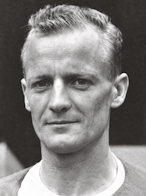
Leonard Francis Carney was an unusual character in Liverpool's football history. A university graduate, history teacher and eventually headmaster of Chadderton Grammar School in Oldham, he combined his academic career with a passion for football and, during the Second World War, distinguished military service. Carney played amateur football for Liverpool University, Northern Nomads, Marine and Collegiate Old Boys before joining Liverpool in 1939. He had already made a handful of league appearances before the outbreak of war interrupted his football career. During the wartime competitions, he became a useful member of Liverpool's side, scoring regularly as well as contributing to the team's forward play. His wartime record is generally recorded as 33 appearances and 15 goals, although surviving statistical records differ slightly depending on which matches are included. Carney also served in the British Army during the war and was awarded the Distinguished Service Order (DSO) for his bravery during the Italian campaign. It was an extraordinary distinction for a man whose peacetime profession was education and whose footballing ambitions had largely been pursued at amateur level.
By the time competitive league football resumed in August 1946, Carney was 31 and still working as a schoolmaster. His opportunity to make a name for himself at the highest level came on the opening day of the 1946/47 season, when Liverpool travelled to Sheffield United on 31 August. The team selection attracted attention, with Carney preferred to club captain Willie Fagan following an impressive performance in a trial match. The Daily Mirror introduced him to its readers with the memorable headline: "Len Carney, fair-haired schoolmaster, crashes into big-time football." It was an unusual story even by football's standards: a decorated war hero and headmaster making his Football League debut in his early thirties. Carney made the occasion particularly memorable by scoring the only goal of the game at Bramall Lane. With the match seemingly heading for a goalless draw, he rose to meet a cross from Berry Nieuwenhuys and directed a gliding header into the net in the dying moments. His last-minute intervention secured two valuable points for George Kay's side and gave the schoolmaster a dream introduction to League football. The victory was the beginning of an eventful campaign for Liverpool. Although the team made an inconsistent start, they eventually found their rhythm and went on to capture their fifth First Division championship, their first League title since 1923. Carney's contribution to that historic season was brief, however. He retained his place for Liverpool's next fixture, a 1-0 home defeat against Middlesbrough, but did not feature again in the League that season. His goal at Sheffield United consequently remained his only one in competitive league football for the club.
Carney continued to be available to Liverpool and made four further appearances during the 1947/48 season, bringing his final Football League record to six appearances and one goal. He eventually left the club in 1948. His football career may have occupied only a small part of his life, but Carney's story is a reminder of the remarkable individuals who emerged from the wartime era.