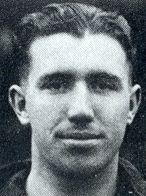
William Thomas Bush, known as Tom, was born in Shropshire in 1914. His family later moved to Liverpool, where his father became a hotel proprietor. A versatile half-back, Bush began his football career as a centre-forward and made his Liverpool first-team debut at the age of 19 in a 1–1 draw against Wolverhampton Wanderers on 30 December 1933. He was credited with creating Alf Hanson's goal, although a contemporary report observed that he was “cool and kept position well, but he lacked experience against a big and sure defence.” Bush's second appearance came just two days later, on New Year's Day 1934, when Liverpool suffered a humiliating 9–2 defeat against Newcastle United at St James' Park. It would be almost three years before he made his third first-team appearance. By the outbreak of the Second World War in September 1939, however, he had established himself in the side and made 65 appearances in all competitions. Bush's only Liverpool goal during this period came in a 3–1 victory over Sunderland on 17 December 1938.
Bush returned to Anfield after the war, but the end of hostilities brought personal heartbreak alongside the prospect of resuming his football career. During Liverpool's preparations for the 1946/47 season in America, he travelled across the Atlantic to be at the bedside of his nine-month-old daughter, Christine Ann Bush, who tragically died on 29 May 1946. Liverpool went on to win the First Division title in 1946/47, and Bush contributed three appearances to the championship campaign. His final league appearance came against Preston North End on 7 April 1947, more than 13 years after his debut.
A contemporary assessment published in the Liverpool Echo on 18 February 1939 offered an insight into Bush's playing style and character: “Tom is rather leggy and does not appear to move quickly, but those long strides of his give one an erroneous impression. He may not be as effective as one would like with the ball on the ground, but taking his assets as a whole they represent a formidable list for an opposing centre forward.” The newspaper also noted his enthusiasm for tennis and swimming, his willingness to support charitable causes and his standing as “one of the game’s good sorts”.
After retiring as a player, Bush remained at Liverpool and became an important figure in the club's youth development system. For many years, he helped prepare promising youngsters for the reserves and, ultimately, the first team. His responsibilities extended beyond coaching and player development to the practical administration of the club's A team, including arranging travel, organising meals and handling other day-to-day details. Much of his work took place away from Anfield, where he worked closely with chief scout Geoff Twentyman to identify promising youngsters and interview their parents as Liverpool considered bringing them into the club's youth system. One of Bush's proudest moments came in 1965, when Liverpool won the FA Cup for the first time in their history. Five players associated with his youth development work received winners' medals: Roger Hunt, Ian Callaghan, Tommy Smith, Tommy Lawrence and Gerry Byrne. Their success was a fitting recognition of the work undertaken behind the scenes to develop the next generation of Liverpool players.
Apart from his wartime service, Bush spent 37 years at Liverpool, contributing to the club both on the pitch and through his long service in youth development and administration. Although his playing career never received the same recognition as that of some of his contemporaries, his contribution to nurturing future generations helped shape Liverpool's success for years to come.