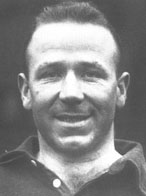
Matt Busby formed an outstanding all-Scottish half-back line at Liverpool alongside Tiny Bradshaw and Jimmy McDougall, a trio that ranks among the finest the club has fielded in those three positions at the same time. Busby began his football career with Alpine Villa, where he won the Scottish Under-18 Cup, before moving to Denny Hibernian. Both Rangers and Celtic had shown an interest in him, but neither move materialised. When Busby went on trial at Rangers, the club discovered that he was a Catholic, while Celtic were reportedly unimpressed by his association with their Glasgow rivals.
In February 1928, Busby moved south to join Manchester City as an inside-forward, but the club converted him into a half-back, a position in which his talents became much more apparent. Busby was relieved to establish himself in professional football, later reflecting on the limited opportunities available to working-class boys of his generation: “There were only two ways for boys to go in those days: down, working in the pits, or up if you happened to be good at football.” He made 226 Football League appearances for City over seven years. Busby's biggest disappointment was losing the 1933 FA Cup final 3–0 to Everton, but he gained a winner's medal the following year when City defeated Portsmouth 2–1 in the 1934 final.
At 26, Busby was an experienced professional when Liverpool signed him from Manchester City in March 1936 for £8,000. The transfer attracted considerable attention, and the Liverpool Echo outlined what supporters could expect from their new acquisition. In its assessment on 12 March 1936, the newspaper described Busby as “a beautiful stylist at half back” and praised his ability to control the ball so cleanly that he could collect it and move it forward in one fluent action. The report also noted that his career in England had taken off only after he moved from the forward line into midfield. Busby almost immediately took over the right-half position from Robert Savage. His distribution, close control and ability to turn defence into attack quickly made him an important member of the side. In September 1936, the Liverpool Echo delivered another remarkable tribute, describing him as “the richest and most practised passer the game has ever known” and added: "Busby goes far up if so inclined and when he starts his upward trend one knows his command of the ball will be such he will not be dispossessed." In September 1937, after a match against Leeds United, Busby was described as a tireless worker who kept the opposition's left wing under control while continuing to contribute to Liverpool's attacks. These accounts illustrate how he combined defensive discipline with the ability to dictate the direction and tempo of his team's play.
Despite Busby's consistency, Liverpool remained a largely modest First Division side during his Anfield years. He became one of the club's most dependable players and led his side out as captain for the first time on 29 March 1937 against his former club Manchester City at Maine Road, although the occasion ended in a heavy 5–1 defeat. He held the position as captain until, like so many of his contemporaries, his playing career was interrupted by the outbreak of the Second World War.
In May 1944, Liverpool appointed Busby as coach and assistant manager to George Kay on a salary of £10 a week, with the intention that he would take up the position when the war ended. On 14 February 1945, Busby, who was then serving as an instructor at the Royal Military College, asked to be released from his coaching contract because he had received other offers. A few days later, he accepted the managerial position at Manchester United. Curiously, Busby continued to be registered as a Liverpool player after accepting the United job. He played for Liverpool until April 1945 and was still prepared to turn out for the club as late as September, although Liverpool politely declined. He formally took charge at Old Trafford on 1 October 1945.
Busby's decision to manage Manchester United proved a defining moment in English football history. He built the celebrated Busby Babes, won five First Division championships and two FA Cups, and survived the Munich air disaster of February 1958, which claimed the lives of eight United players and devastated the club. After rebuilding the team, he achieved the greatest triumph of his managerial career in 1968, when Manchester United defeated Benfica 4–1 at Wembley to become the first English club to win the European Cup. Knighted for his services to football, Sir Matt Busby is rightly remembered as one of the game's most influential managers. His achievements at Manchester United overshadow his playing career, but his years at Liverpool were an important chapter in his development.