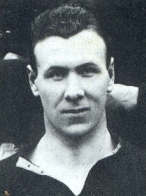
Few Liverpool players have carried a less appropriate nickname than Thomas "Tiny" Bradshaw. Standing well over six feet tall and possessing a commanding physique, the Scottish international was one of the most imposing defenders in British football during the 1930s. Yet those who watched him regularly knew there was much more to his game than strength and stature. Bradshaw arrived at Anfield in January 1930 after eight productive years with Bury, where he had gained extensive First and Second Division experience. Liverpool invested a club-record £8,000 to bring him to Merseyside, a significant statement of intent from manager George Patterson. Two years earlier he had earned his place in football folklore. On 31 March 1928 he represented Scotland against England at Wembley in the celebrated 5-1 victory that produced the legendary "Wembley Wizards." Bradshaw received the only full international cap of his career in the match and was entrusted with containing England's greatest attacking threat, Everton's prolific centre-forward Dixie Dean. Scotland's dazzling display became one of the defining performances in the history of the international game.
Bradshaw made his Liverpool debut against Manchester United in January 1930 and immediately strengthened a side searching for consistency. Initially employed at right-half, he appeared in the final seventeen league fixtures of the 1929-30 campaign before establishing himself permanently at centre-half. Over the next eight years he became the cornerstone of Liverpool's defence. Contemporary observers admired the way Bradshaw combined physical authority with technical skill. A newspaper profile of 1937 credited him with adding "backbone" to Liverpool's side and praised his ability to operate effectively in tight situations. The article also highlighted his role as a leading practitioner of the evolving defensive system of the period, demonstrating that his reputation extended beyond mere strength or aerial ability. Off the field, Bradshaw was portrayed as an intelligent and reserved character whose preferred companions were books, particularly thrillers.
By the start of the 1931/32 season Tiny had become one of Liverpool's leaders and later captained the club through much of the decade. Although the Reds failed to challenge seriously for major honours during those years, Bradshaw's consistency never wavered. Supporters regarded him as one of the division's most reliable centre-halves, while opponents respected his honesty and sportsmanship. His duels with Everton's Dixie Dean became a regular feature of Merseyside football during the early 1930s. Everton’s goal machine, Dixie, had great respect for Tiny: "In all the times I played against him he never used any of those sly little tricks that others did, like pulling you back by your shirt or shorts. Tiny went out to play football and let the best man win." Leslie "Bee" Edwards at the Liverpool Echo, who was regarded for decades as a leading authority on football in Liverpool, was also a firm admirer of the big man: "A giant at 6ft 3in [190 cm], but amazingly agile. He had the build of Ron Yeats and the touch of Alan Hansen, who were also Scottish. Tiny was a marvellous defender and the only man I have ever seen come anywhere near him was John Charles.’
Bradshaw's greatest quality may have been his dependability. Between 1930 and 1938 Liverpool built much of their defence around him, and he accumulated 291 senior appearances for the club. In an era of tactical change, he adapted successfully from wing-half to centre-half and provided a reassuring presence during a period of transition. His Anfield career ended in 1938. What followed was an unusual sequence of transfers. He briefly appeared for South Liverpool before joining Third Lanark almost immediately, a move that left him technically a South Liverpool player for only a matter of days. After a season back in Scotland he returned to South Liverpool during the summer of 1939, shortly before the outbreak of the Second World War. Tiny remains one of the most respected defenders of Liverpool's inter-war period: a commanding centre-half, a club captain, a Wembley Wizard, and a player whose influence on the Reds far exceeded the modest honours recorded beside his name.