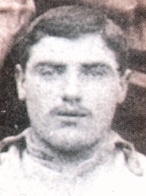
Thomas Henry Bradshaw, known as Harry, was one of Liverpool’s earliest crowd favourites and the first player to win an international cap while representing the club. A versatile forward who could lead the attack or play on either wing, he combined speed with close control and accurate crossing. His partnership with Frank Becton on Liverpool’s left became particularly admired, helping establish his reputation beyond Anfield. On 20 February 1897 he played outside-left for England in a 6–0 victory over Ireland at Trent Bridge, making a small piece of history for a club still less than five years old. A Liverpool-born footballer, Bradshaw developed his game locally before spending time with Everton’s reserves in the Lancashire Combination for one season and Northwich Victoria in the Second Division. He joined Liverpool in October 1893 and made his debut at centre-forward in a 5–0 victory at Woolwich Arsenal on 28 October. He contributed seven goals in 14 league appearances as Liverpool completed their first Football League campaign unbeaten and won the second division championship. The following season brought relegation, but Bradshaw provided one of the brighter aspects of a difficult year. He appeared in all 30 league matches, the only Liverpool player to do so, and scored 17 goals. Another second division championship followed in 1895/96, when he contributed 11 league goals while increasingly operating on the wing.
Bradshaw’s effectiveness was not confined to his own scoring. Alongside Becton, he helped create a left-wing partnership capable of drawing defenders out of position through quick exchanges. An appreciation reproduced in the Lancashire Evening Post on 30 December 1899 described how the pair would carry the ball almost within tackling distance before slipping it to one another. While one advanced, the other moved into position for the return pass or made for goal to meet a cross. Their understanding made them both entertaining to watch and difficult to contain. There were frustrations, too. Bradshaw sometimes prolonged his dribbling when teammates were waiting for a pass. Looking back in September 1915, the Star Green ’un recalled that this tendency had become more noticeable towards the end of his Liverpool career. The same account, however, remembered his acceleration and the quality of his combination play with Becton. It also attributed an affectionate assessment to Tom Watson: “Bradshaw was always worth his money if only as an exhibition footballer.”
Bradshaw's England appearance confirmed the standing he had earned at Liverpool, although it proved to be his only international cap. Lloyd’s Weekly Newspaper, writing on 28 February 1897, praised his pace and crossing and ranked him among the country’s most promising forwards. It also observed that he had received relatively few opportunities to distinguish himself against Ireland despite England’s comfortable victory. Football was not his only sporting accomplishment: the same profile drew attention to his ability as a cricketer. Bradshaw left Liverpool for Tottenham Hotspur in May 1898 with 51 goals from 138 senior appearances. The move reunited him with Frank Brettell, who had recently taken charge at Spurs. Bradshaw played 52 matches and scored 13 goals during his single season with Tottenham before joining Thames Ironworks, the future West Ham United, in 1899 and becoming captain.
Bradshaw's final appearance came against Millwall on 9 December 1899, when he scored in a 2–1 defeat. A leg injury forced him to rest, but on Christmas morning he felt well enough to watch Tottenham play Portsmouth. According to the Dundee Courier, a journalist who spoke to him at the match heard that he expected to be fit to play again in a few weeks. After watching the Portsmouth game, Bradshaw returned to his home at 5 Shelbourne Road, Tottenham, where he became violently sick and complained of severe pains in his head and chest. Before a doctor could reach him, the 26-year-old suffered a fit and died. Players from both Thames Ironworks and Queen’s Park Rangers wore black armbands when the clubs met five days later. The inquest, reported in the Illustrated Police News on 6 January 1900, heard that Bradshaw had suffered persistent headaches and ear trouble after receiving two kicks to the head on successive Saturdays four years earlier. His friend and Tottenham player John Jones described how heading could cause him considerable pain. Harry had to put his hands to his ears to ease the suffering. Dr Hugh Davis found that death had resulted from a ruptured blood vessel on the brain. He considered a connection with the old injury possible but could not establish it conclusively, and the jury attributed the rupture to natural causes. On 2 April 1900 Tottenham and Thames Ironworks played a benefit match for his widow and two young children. The tributes also remembered his wider sporting promise: the Lancashire Evening Post reported that he had been qualifying for Essex through residence and suggested that the county had lost a potentially valuable cricketer as well as football losing a gifted forward.