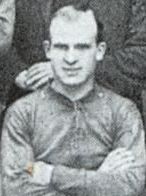
Bovill’s Liverpool career was brief, but his best performances included decisive contributions against Manchester United and Woolwich Arsenal. A skilful Scottish forward, he had passed through Rangers and Blackburn Rovers before establishing himself at Chesterfield Town. When Chesterfield lost their Football League status in 1909, he remained with them for two seasons in the Midland League, scoring 31 goals in 77 appearances before Liverpool brought him back into the First Division in April 1911.
Bovill arrived to Liverpool with encouraging recommendations. Reporting Liverpool’s annual meeting in June 1911, the Liverpool Echo noted that Tom Watson had spoken favourably of the reports received about him. The Athletic News subsequently listed the newcomer at 5ft 7½in (171 cm) and 10st 10lb (68 kg). His principal assets were his close control, passing and ability to create openings for his fellow forwards. His debut came in a 2–1 defeat at Bolton Wanderers on 4 September 1911. Although generally used as an inside-forward, he occupied different positions across the attack during his first season. Against Notts County at Anfield on 4 November, he played at centre-forward and scored his first two Liverpool goals in a 3–0 victory, opening the scoring before half-time and adding the second after the interval. Two weeks later came arguably his finest afternoon for the club. Manchester United took the lead at Anfield, but Jack Parkinson quickly equalised before Bovill scored twice in three minutes, in the 75th and 78th minutes. United’s late reply left Liverpool 3–2 winners. Playing at inside-right alongside Parkinson, Bovill had supplied the finishing touch that was too often missing from his otherwise accomplished game. He produced another double against Woolwich Arsenal on 30 December, sharing Liverpool’s goals with Parkinson in a 4–1 win. A week later, he scored in the 3–2 victory at Manchester City. Remarkably, all seven of his Liverpool goals came in those four winning matches between 4 November 1911 and 6 January 1912. He finished his first season with 25 appearances, comprising 23 league games and two in the FA Cup.
Bovill couldn't sustain his most promising spell. He appeared only once in 1912/13 and three times the following season, bringing his Liverpool total to 29 matches and seven goals. The club programme recognised his industry and useful passing along the ground but identified unreliable finishing as his chief weakness. Nevertheless, contemporary accounts suggest that he remained an entertaining footballer. When announcing his departure for Linfield in May 1914, the Liverpool Echo anticipated an attractive partnership with former Everton player Marshall McEwan and described Bovill as “a provider of possible goals rather than a goal-getter”. At Linfield, Bovill enjoyed success that had eluded him at Anfield. He scored the only goal against Belfast Celtic in the 1915 Irish Cup final and helped retain the trophy the following year. His association with Liverpool was still remembered fondly: in November 1915, the Echo recalled the skilful player who had delighted Anfield audiences while reporting on his appearances in Belfast.
Bovill served with the Royal Irish Rifles during the First World War, continuing to play for Linfield while stationed in Ireland. His time with the club extended into a third season before he departed for the Western Front in December 1916. He survived a gas attack in 1917, but its effects ended his football career. He subsequently returned to Rutherglen, where he died on 13 April 1954, aged 68.