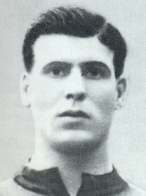
John Bamber, often known as Jack, developed from a right-winger into a highly regarded right-half whose energy and intelligent passing earned him international recognition. Born in Peasley Cross, St Helens, he joined Liverpool from Alexandra Victoria in December 1915 without a transfer fee. Although the First World War delayed his introduction to regular league football, Bamber became a familiar figure in Liverpool’s wartime sides, making 118 appearances and scoring eight goals in those fixtures. By the time national competition resumed in 1919, he had already accumulated considerable experience in a Liverpool shirt.
His competitive debut came in a 2–1 victory over Aston Villa at Anfield on 13 September 1919, the same afternoon that Tommy Lucas made his first appearance. Bamber played 23 league matches and five FA Cup ties during that first post-war season, establishing himself as an effective member of the half-back line. His contribution depended less on spectacular individual moments than on winning possession, supporting his colleagues and using the ball constructively. The club programme recognised these qualities in March 1920: “Since coming to Anfield his consistency has been remarkable. Never really brilliant, but always very effective, Bamber is the type of player who is bound to make a name for himself; he discards all idea of ornamentality for efficiency, and seldom is it that the keenest critic can find fault with his work in the field.” His reputation was already spreading beyond Merseyside. That month he represented the Football League in a 4–0 victory over the Scottish League at Hampden Park, and he was selected again for the corresponding fixture at Highbury a year later.
Bamber’s development continued in 1920/21, when he made 30 league appearances and played in three FA Cup ties. The greatest personal distinction of his career came on 14 March 1921, when he won his only England cap in a goalless draw against Wales at Ninian Park. He was one of three Liverpool players making their England debuts that afternoon, alongside fellow half-back Tom Bromilow and forward Harry Chambers. His selection placed him among the leading English players in his position, although further international opportunities never followed. Contemporary praise suggests that his value extended well beyond defensive work. In April 1921, the Derby Daily Telegraph described him as “a powerful defender, a sixth forward, a breaker-up and forager rolled into one. Has a wonderful stock of energy, delights in loading upon his forwards the choicest of delicate ground passes, and is an artist.” It was a striking assessment of a player capable of disrupting the opposition’s attacks and then supplying his own forwards with carefully judged passes.
Bamber began the 1921/22 season in possession of his place, playing Liverpool’s opening four league matches, but appendicitis abruptly interrupted his progress. His absence gave Jock McNab the opportunity to establish himself, and Bamber was unable to regain a regular position after recovering. He finished the season with eight league appearances and managed only four during the following campaign. Liverpool won the championship in both years, but Bamber’s limited involvement left him without a winner’s medal. Having earned an England cap shortly before Liverpool’s rise to the summit, he found himself on the fringes during the club’s greatest successes of the period. Six further appearances followed in 1923/24 before Bamber moved to Leicester City in February 1924.
Bamber left Liverpool with 79 competitive appearances and two goals. At Filbert Street he became an important member of the side that won the Second Division championship in 1924/25, finally enjoying a substantial role in a title-winning campaign. He then played regularly during Leicester’s first two seasons back in the First Division, alongside another former Liverpool player, Harold Wadsworth. Bamber returned to Merseyside in 1927 to join Tranmere Rovers, spending three seasons at Prenton Park before moving into non-league football with Prescot Cables in 1930. His later success at Leicester demonstrated that the loss of his Liverpool place had not ended his usefulness as a league footballer. At Anfield, however, his career remained one of interrupted promise: an accomplished half-back whose illness opened the door for a rival just as Liverpool were developing into champions.