
George Allan
Forward · Liverpool 1895–1897, 1898–1899
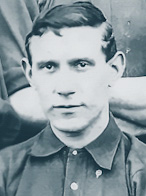
Personal
- Born
- 23 August 1875
- Place of birth
- Linlithgow Bridge, Scotland
- Died
- 16 October 1899
- International
- 1/0 Debut 03.04.1897 vs. England
- Other clubs
- Vale of Avon, Linlithgow Athletic, Broxburn Shamrock (1891-93), Bo'ness (1893-94), Leith Athletic (1894-95), Celtic (1897-98)
At Liverpool
- Signed from
- Leith Athletic / Celtic
- Joined
- 12 June 1895
- Debut
- 14 September 1895
- First goal
- 21 September 1895
- Last goal
- 22 April 1899
- Last appearance
- 29 April 1899
- Left the club
- 1 May 1897
Liverpool career
- League 79 apps · 48 goals
- Win ratio 55.21% — W 53 · D 18 · L 25
- Assists not recorded before 1945–46
Honours
- Second Division
- 1895-96
Player profile
George “Dod” Allan was Liverpool’s first outstanding Football League goalscorer, a centre-forward whose strength and speed were matched by his willingness to confront defenders. Described as “a model centre; of fine physique, great speed and no fear”, he possessed the qualities needed to thrive in the physically demanding football of the late nineteenth century. At a reported 5 ft 10 ins and 13 st 6 lbs—approximately 178 cm and 85 kg—he was a substantial presence in the forward line. His arrival from Leith Athletic in 1895 involved more than one complication. Scottish agent Peter D. Allan later recalled recommending the young forward to Liverpool after seeing him play at Perth. Burnley had already persuaded him to sign a Football League form, but, having been unimpressed by a subsequent performance, accepted £2 from Liverpool and tore up the document. The agent related the story in an interview reproduced by the Burnley Express in September 1897. There was also a dispute concerning a contract Allan had signed with St Bernard’s in Edinburgh. The matter went before the Scottish Football Association and resulted in a suspension lasting until the end of November 1895, after which his position as a Liverpool player was recognised. It interrupted an exceptionally promising introduction to English football, but did little to prevent him becoming a central figure in Liverpool’s campaign.
Allan made his debut in the 5–1 victory over Newcastle United at Anfield on 14 September 1895. His first goal followed a week later in a 4–2 win at Loughborough, and his third appearance brought a much more emphatic demonstration of his ability: four goals in Liverpool’s 5–1 defeat of Burslem Port Vale. Another two against Crewe Alexandra gave him seven goals in his first four league appearances. Liverpool had found a young forward capable of turning chances into goals at an extraordinary rate. After his enforced absence during which he missed seven league matches, Allan resumed scoring and repeatedly punished opposing defences. He struck a hat-trick in the 5–0 victory at Rotherham Town in January 1896, then scored four when the same opponents were beaten 10–1 at Anfield the following month. Another hat-trick came in a 7–0 win at Crewe in March. Those three matches, together with his four-goal performance against Port Vale, accounted for fourteen of his 25 league goals. He reached that total in only twenty appearances, averaging 1.25 goals per game as Liverpool won the Second Division championship. Winning the division did not itself guarantee promotion under the system then in use. Liverpool still had to negotiate the end-of-season Test Matches against Birmingham City and West Bromwich Albion. Allan scored in both home victories, a 4–0 success against Birmingham and a 2–0 win over Albion, helping Liverpool secure their return to the First Division.
The step up to the First Division brought stronger opposition, but Allan remained Liverpool’s leading scorer. He began 1896/97 by scoring both goals in a 2–1 victory at Sheffield Wednesday and contributed important strikes throughout the season. His league goals included doubles against Bury and Bolton Wanderers, while in the FA Cup he scored against Burton Swifts and supplied the only goal of the quarter-final replay at Nottingham Forest. Liverpool reached the semi-final before losing to Aston Villa and finished fifth in the league, with Allan recording fifteen league goals and two in the cup across 34 appearances.
Allan returned to Scotland in May 1897 to join Celtic, carrying with him the reputation he had established as one of Liverpool’s outstanding early forwards. He had already represented Scotland against England while an Anfield player, and his scoring ability quickly made an impression in Glasgow. During his solitary season at Celtic, he scored 15 goals in 17 league appearances as the club secured its fourth Scottish championship. Seven of those goals came against Clyde: two in a 6–1 victory in September and five in a remarkable 9–1 win on Christmas Day. With another goal in the Scottish Cup, he finished the campaign with 16 goals in 19 appearances across the two competitions. Liverpool retained his Football League registration and paid £50 to bring him back for the 1898/99 season. Contemporary assessments praised his control, speed and ability to direct the forward line, while the Manchester Courier later credited Jimmy Ross with helping his development at Anfield. Particularly dangerous was Allan's ability to shoot while turning: with his back almost towards goal, Allan could swing round and strike with considerable power, giving a goalkeeper little time to anticipate where the ball would go.
Allan's second spell began more slowly in front of goal. Allan failed to score in his first six league appearances before opening his account against reigning champions Sheffield United at Anfield on 29 October 1898. That match also produced the confrontation with William “Fatty” Foulke that became one of the most frequently retold incidents of Liverpool’s Victorian years. Allan was prepared to challenge the imposing goalkeeper physically, and contemporary reports described Foulke catching him by the leg and upending him as he rushed into the goalmouth. The referee awarded Liverpool a penalty, which Andrew McCowie converted. Allan also scored in the 2–1 victory, ensuring that his contribution to the afternoon was remembered for more than his encounter with the goalkeeper. The story grew considerably in the telling. In a 1916 interview, Foulke disputed the most dramatic versions and said that he and Allan had been friends away from the pitch. His recollection was that he had bent forward to protect himself as Allan charged, causing the Liverpool forward to strike his shoulder and tumble over him. Foulke acknowledged that Allan had suffered a heavy fall, but particularly resented the penalty that followed. Whatever the precise mechanics of the collision, both the contemporary reports and Foulke’s later account establish a forceful confrontation that helped Liverpool overturn Sheffield United’s lead.
Their rivalry continued during Liverpool’s FA Cup run that spring. Allan scored in the 2–0 victory over Blackburn Rovers in the opening round and then faced Foulke again in a prolonged semi-final contest. He found the net in the 2–2 draw with Sheffield United at Nottingham’s City Ground on 18 March and scored again in the extraordinary 4–4 replay at Bolton five days later. Liverpool eventually lost 1–0 in the deciding meeting at Derby on 30 March. Allan’s three cup goals contributed to a season total of 11 in 36 appearances, eight of them coming in the League. There was still a league championship to pursue. Liverpool’s challenge lasted until the final fixture, when they travelled to Aston Villa on 29 April 1899 needing victory to take the title. Instead, Villa won 5–0 and Liverpool finished runners-up. For Allan, the disappointment carried a significance nobody could then have understood: it was his final competitive appearance for the club. Within months, a player who had been central to Liverpool’s ambitions in both major competitions would be fighting a fatal illness.
After returning to Scotland for the summer, Allan became seriously ill and was unable to report for training before the 1899/1900 season. Liverpool initially retained some hope of his recovery. The Liverpool Mercury’s August preview acknowledged how much his leadership of the attack had contributed to the previous campaign and expressed the wish that his lung complaint wouldn't prevent him playing again. By September, however, Tom Watson’s words revealed the growing concern: “Diseased lungs are not cured in a day. Allan’s absence is now beginning to be felt, and we are able to estimate him at his worth. Poor old George!” Watson visited Allan shortly before his death and was distressed by the speed of his physical decline. The Manchester Courier reported that the once powerful young footballer had become stooped and prematurely aged in only a few months. Allan died of tuberculosis at his mother’s home in Elie, Fife, on 16 October 1899, aged just 24.
Appearances per season
| Season | League | FA | LC | Europe | Other | Total |
|---|---|---|---|---|---|---|
| 1895-1896 | 20 | 2 | 0 | 0 | 4 | 26 |
| 1896-1897 | 29 | 5 | 0 | 0 | 0 | 34 |
| 1898-1899 | 30 | 6 | 0 | 0 | 0 | 36 |
| Totals | 79 | 13 | 0 | 0 | 4 | 96 |
A more detailed look at the player's appearances
| Apps | Mins | Opponent |
|---|---|---|
| 96 | 8,640 | All opponents |
| 8 | 720 | West Bromwich Albion |
| 7 | 630 | Sheffield United |
| 5 | 450 | Aston Villa |
| 5 | 450 | Blackburn Rovers |
| 5 | 450 | Nottingham Forest |
| 4 | 360 | Burnley |
| 4 | 360 | Bury |
| 4 | 360 | Derby County |
| 4 | 360 | Newcastle United |
| 4 | 360 | Preston North End |
| 4 | 360 | Stoke City |
| 4 | 360 | Sunderland |
| 4 | 360 | Wolves |
| 3 | 270 | Bolton Wanderers |
| 3 | 270 | Burton Swifts |
| 3 | 270 | Everton |
| 3 | 270 | Sheffield Wednesday |
| 2 | 180 | Birmingham City |
| 2 | 180 | Crewe Alexandra |
| 2 | 180 | Grimsby Town |
| 2 | 180 | Lincoln City |
| 2 | 180 | Loughborough |
| 2 | 180 | Manchester City |
| 2 | 180 | Notts County |
| 2 | 180 | Rotherham Town |
| 1 | 90 | Arsenal |
| 1 | 90 | Burton Wanderers |
| 1 | 90 | Darwen |
| 1 | 90 | Manchester United |
| 1 | 90 | Millwall |
| 1 | 90 | Port Vale |
| Total | Venue |
|---|---|
| 47 | Home |
| 45 | Away |
| 4 | Neutral |
| Total | Competition |
|---|---|
| 79 | League |
| 13 | FA Cup |
| 4 | Test Match |
| Total | W | D | L | Win% | Manager |
|---|---|---|---|---|---|
| 70 | 33 | 16 | 21 | 47.1% | Tom Watson |
| 26 | 20 | 2 | 4 | 76.9% | John McKenna |
Goals per season
| Season | League | FA | LC | Europe | Other | Total |
|---|---|---|---|---|---|---|
| 1895-1896 | 25 | 1 | 0 | 0 | 2 | 28 |
| 1896-1897 | 15 | 2 | 0 | 0 | 0 | 17 |
| 1898-1899 | 8 | 3 | 0 | 0 | 0 | 11 |
| Totals | 48 | 6 | 0 | 0 | 2 | 56 |
The player scored 56 goals in 40 different matches.
A more detailed look at the player's goals
| Total | Opponent |
|---|---|
| 7 | Rotherham Town |
| 5 | Crewe Alexandra |
| 4 | Port Vale |
| 3 | Blackburn Rovers |
| 3 | Burton Swifts |
| 3 | Bury |
| 3 | Sheffield United |
| 3 | Sheffield Wednesday |
| 2 | Bolton Wanderers |
| 2 | Grimsby Town |
| 2 | Lincoln City |
| 2 | Preston North End |
| 2 | Stoke City |
| 2 | West Bromwich Albion |
| 2 | Wolves |
| 1 | Aston Villa |
| 1 | Birmingham City |
| 1 | Burnley |
| 1 | Burton Wanderers |
| 1 | Loughborough |
| 1 | Manchester City |
| 1 | Millwall |
| 1 | Newcastle United |
| 1 | Nottingham Forest |
| 1 | Notts County |
| 1 | Sunderland |
| Total | Started/substitutions |
|---|---|
| 56 | Started |
| Total | Competition |
|---|---|
| 48 | League |
| 6 | FA Cup |
| 2 | Test Match |
| Total | Goal minute period |
|---|---|
| 12 | 1-15 minutes |
| 9 | 16-30 minutes |
| 7 | 31-45 minutes |
| 5 | 46-60 minutes |
| 5 | 61-75 minutes |
| 6 | 76-90 minutes |
Related Articles
One-Cap Wonders!
Owen Collins looks at the players who have gained international recognition without necessarily making the grade at the club but particularly one name on this list is a great surprise given his success.
Suarez plays his 100th game
Luis Suarez has scored 54 goals in 100 games for Liverpool. Who has scored most goals after a century of matches for the club?
How does Sturridge compare with Liverpool's best?
In Daniel Sturridge's first 25 games for Liverpool there has not been a more prolific striker at that juncture since 1914. But who is on top of that list? Revealed! - the 15 most prolific strikers after playing a quarter of a century of games for the Reds.
George Allan – As a rule he was a scrupulous player
From Manchester Courier on 23 October 1899.
George Allan's and Fatty Foulke's legendary duel
One of Liverpool's first star forwards, George Allan, was involved in a colorful incident with Sheffield United's goalkeeper, William Fatty Foulke which gained legendary status.
1899-1901: Liverpool champions for the first time!
Liverpool won the league in the 1900-01 season. We give you unique insight into the local papers' reports and celebration of this glorious feat!
1893-1896: Liverpool rocking between 2nd and 1st division
After winning the Lancashire league Liverpool's climb up the league ladder started in 2nd division. A real fairytale season was ahead and the club's biggest game to date against the most famous club in England in the FA Cup.
Liverpool run riot at Anfield
From 'Liverpool - A Complete History 1892-1986' on Liverpool - Rotherham United on 18.02.1896.