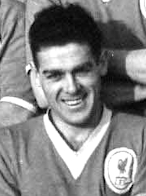
Bimpson could make a considerable impression in a short space of time. His four first-half goals against Burnley remain the outstanding example, but his Liverpool career also included a memorable introduction against the same opponents, the challenge of replacing Billy Liddell and repeated efforts to turn reserve-team goals into a lasting first-team place. Bimpson joined Liverpool from Burscough on 28 January 1953. A physically substantial forward, listed by the Liverpool Echo at six feet and 12 stone 4 pounds, he offered an option through the middle or elsewhere across the attack. His early progress was striking. On 28 February, barely a month after signing, he scored all three Liverpool goals in a 3–2 friendly victory over Burnley at Anfield. The attendance of 22,119 meant that plenty of supporters had seen his finishing before he made his competitive debut. That debut came at Aston Villa on 7 March 1953, although a 4–0 defeat provided a sobering introduction to First Division football. His first competitive goal followed against Cardiff City at Anfield on 3 April, and he scored again at Arsenal the following day. He rounded off his first season by scoring Liverpool’s second in a 2–0 home victory over Chelsea, giving him three goals from eight league appearances.
There was an unusual birthday celebration during Liverpool’s subsequent tour of North America in 1953. On 14 May, the day he turned 24, Bimpson scored twice against an Irish All Stars side at Ebbets Field in Brooklyn. Liddell supplied the other two goals in Liverpool’s 4–0 victory, although Bimpson’s afternoon ended with an injury that forced him off the field. His most productive Liverpool season was indeed the 1953/54 campaign, when he scored 12 times in 24 league appearances. Two goals in four minutes helped Liverpool to a 4–4 draw with Manchester United at Anfield on 22 August. Then, on 19 September, he overwhelmed Burnley, scoring in the second, sixth, 22nd and 44th minutes as Liverpool won 4–0. Having already scored a friendly hat-trick against them in February, he had now put seven goals past Burnley in two Anfield appearances that year. These were remarkable individual performances in a season that ultimately brought relegation.
The move into the Second Division did not establish Bimpson as a permanent selection. He made eight league appearances in each of the next two seasons, scoring twice in 1954/55 and failing to score in 1955/56. Contemporary coverage nevertheless suggests a player who kept pressing his case. The Liverpool Echo’s season preview of 27 August 1955 regarded him as a committed and useful reserve option. Four days later, the paper reported that Bimpson and centre-half Alex South were the reserves’ most improved players. Bimpson had averaged a goal a game across four successive victories, and the assessment relayed to the columnist was that he was playing better than at any previous stage of his Liverpool career. His versatility extended beyond centre-forward and inside-right. In September 1954, the Echo announced his selection at outside-right for the reserves, with fellow centre-forward Alan Arnell on the opposite wing. By September 1956, the newspaper was noting that Bimpson remained Liverpool’s second-highest scorer despite operating in an unfamiliar wide position. He finished 1956/57 with six goals in 21 league appearances, his busiest league campaign after the relegation season.
One of Bimpson's most significant opportunities arrived in October 1958. The Daily Mirror reported on 17 October that Liddell had been dropped for the first time in his long Liverpool career, with Bimpson taking his place at centre-forward against Fulham. It was a selection certain to attract attention, and Bimpson supplied the ideal response. With seven minutes remaining at Craven Cottage, he scored the only goal, with Alan A’Court credited with the assist. That match began Bimpson's most productive spell in the Second Division. He scored in subsequent victories over Stoke City and Leyton Orient, opened the scoring against Swansea Town and struck twice in the 4–0 defeat of Rotherham United on 27 December. His return for 1958/59 was 11 goals in 15 league appearances. Yet even that scoring rate did not secure his position for the following season.
Bimpson’s final Liverpool appearance came in the 1–1 draw with Portsmouth at Anfield on 24 October 1959. His departure was already being prepared before Dave Hickson completed his move from Everton. On 4 November, Leslie Edwards reported in the Liverpool Echo and Evening Express that Liverpool were willing to consider offers for Bimpson, Arnell and Gerry Byrne. Hickson signed two days later, and Bimpson joined Blackburn Rovers on 19 November. Blackburn offered a return to the First Division and, within months, a place in an FA Cup final. Bimpson scored against Sunderland in a 4–1 third-round replay victory and twice in the 3–1 fifth-round win at Tottenham. At Wembley on 7 May 1960, he wore the number seven shirt against Wolverhampton Wanderers. Rovers lost 3–0, their task made considerably harder when Dave Whelan suffered a broken leg before half-time. Bimpson’s Blackburn career produced eight goals in 29 first-team appearances.
After a brief spell with Bournemouth & Boscombe Athletic, Bimpson joined Rochdale in 1961 and reached another major domestic final. He played at centre-forward in both legs of the 1962 League Cup final against Norwich City, which the Fourth Division club lost 4–0 on aggregate. His later career took him to Wigan Athletic and back to Burscough. Bimpson died on 13 November 2021, aged 92, leaving a Liverpool record distinguished by bursts of prolific scoring during some of the club’s most difficult post-war years.