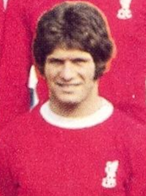
Boersma’s Liverpool career brought important goals, championship success and considerable frustration. A forward who could also operate in midfield, he repeatedly demonstrated his usefulness without securing a permanent place in a side increasingly built around Kevin Keegan, John Toshack and Steve Heighway. His eventual return as a member of the coaching staff added another chapter to an association that had begun in Liverpool’s junior ranks. Boersma joined the club in 1965 and turned professional in September 1968. His first-team debut provided a memorable twentieth birthday, although the result was disappointing: he appeared as a substitute in the 3–2 league cup defeat at Manchester City on 24 September 1969. He made six senior appearances that season and also gained experience on loan at Wrexham in 1970. His first Liverpool goal came in circumstances that illustrated the opportunities available to a reserve forward. Sent on for Alun Evans after only 15 minutes against Dinamo Bucharest on 4 November 1970, Boersma scored shortly after half-time to earn a 1–1 draw. Liverpool progressed 4–1 on aggregate in the Fairs Cup. With Evans unavailable, Boersma then enjoyed a sustained run in the side during the winter of 1970/71.
Keegan’s arrival the following summer made the competition fiercer. His partnership with Toshack became central to Liverpool’s attack, leaving Boersma dependent on injuries and changes of selection. When Toshack was injured in September 1972, however, he made a significant contribution to the championship challenge. At Elland Road on 30 September, Boersma helped create Larry Lloyd’s equaliser before scoring the winner himself as Liverpool recovered to beat Leeds United 2–1. It was an outstanding afternoon against one of their strongest rivals.
The 1972/73 campaign was Boersma's most productive complete season, yielding 13 goals in 31 appearances across all competitions. Seven came in the League and four in the UEFA Cup as Liverpool secured the championship and their first European trophy. Although Toshack’s return reduced his opportunities, Boersma had made a substantial contribution to both successes. He remained useful the following season, starting in the FA Cup fifth-round victory over Ipswich Town and scoring an 87th-minute winner against Southampton in the League. Yet the campaign ended with a painful personal disappointment. Omitted even from the substitute’s position for the 1974 FA Cup final against Newcastle United, he left Wembley rather than watch Liverpool’s triumph. The Daily Mirror of 6 May 1974 revealed how deeply the decision had affected him. According to its report, Boersma returned to the team hotel by taxi, missed the celebration banquet and instead watched his girlfriend, actress Sharon Mughan, in a West End play. He also stayed behind when the team travelled home. Believing his Liverpool career was finished, he wanted a transfer to a London club, which would allow him to live nearer the woman he had known since school. The rupture proved temporary. Three months later Boersma was back at Wembley, this time scoring Liverpool’s goal in the Charity Shield against Leeds. The match finished 1–1 before Liverpool won on penalties, although the occasion became better remembered for the dismissals of Keegan and Billy Bremner. For Boersma, it was a striking reversal of his experience in May.
Boersma's best scoring spell followed at the beginning of Bob Paisley’s reign. With Keegan suspended for part of the period, Boersma scored twice in the 3–0 win at Chelsea and then struck a first-half hat-trick against Tottenham at Anfield on 7 September. He supplied Ray Kennedy for the final goal in Liverpool’s 5–2 victory. Boersma added two more in the 11–0 European Cup Winners’ Cup demolition of Strømsgodset on 17 September. By the time Boersma scored against Stoke four days later, he had reached ten goals for the season, including his Charity Shield strike. Remarkably, that September goal proved to be his last for Liverpool. Paisley tried to accommodate him in midfield when Keegan returned, but Boersma again slipped out of the regular side. Reflecting on those years in LFC Magazine, he explained that he had been willing to play anywhere Liverpool needed him. "I was a totally different type to Kevin Keegan. Kevin had come in and done fantastically," Boersma told LFC magazine. "Shanks would always stick by what he thought was his strongest team. He went with Toshack, Keegan and Heighway. I just came in and did my bit and even in that period in '74 when Kevin came back, it was me, Ray Kennedy and Stevie up front. I think he dropped Kevin into midfield for a couple of games. He didn't do too well and we swapped over again. I went into midfield and Kevin went up front. You would play anywhere for them. I would have played left wing, right wing, up front, anywhere. I still enjoyed my time at Liverpool. It was just so difficult to get a chance."
In December 1975 Boersma joined Middlesbrough for £72,000, leaving Liverpool with a goal every fourth game in 120 appearances. At Ayresome Park he formed a lasting friendship with Graeme Souness. Further playing spells followed at Luton Town and Swansea City, where he reunited with Toshack before a broken ankle interrupted his career. He subsequently moved into coaching and physiotherapy. Boersma's association with Souness eventually brought him back to Liverpool in 1991 after they had worked together at Rangers. Their later appointments took Boersma to clubs including Galatasaray, Southampton, Benfica, Blackburn Rovers and Newcastle United.