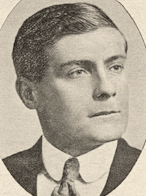
William “Billy” Banks was a compact inside-forward whose promising start at Liverpool was interrupted by the First World War. Born in Cramlington, Northumberland, on 6 December 1893, he developed his football in the north-east, spending three seasons with Hartford Burdon in the Blyth and District League before turning professional with Ashington. Liverpool signed him from Ashington on 29 September 1913, bringing the young forward into Tom Watson’s squad. Standing approximately 5 ft 6½ in, Banks was described as a player whose strength lay in combining with his colleagues rather than producing individual displays. Banks had to wait until 14 March 1914 for his first-team debut, but immediately demonstrated his ability to contribute goals. Selected against Burnley at Turf Moor, he scored Liverpool’s first goal in a match that eventually ended in a 5–2 defeat. He was only 20 years old, and his introduction came during a demanding period in which Liverpool were battling near the foot of the First Division while progressing towards their first FA Cup final.
Four days later, Banks made an even stronger impression on his first appearance at Anfield, scoring twice in a 3–0 victory over Chelsea. Three goals in his opening two matches provided an encouraging start, and he went on to play in nine of Liverpool’s final eleven League fixtures, finishing the campaign with four goals. Although he had broken into the league side, he made no appearances in the FA Cup campaign that culminated in Liverpool’s defeat by Burnley in the final. He remained involved during 1914/15, making seventeen league appearances and scoring twice more. His final competitive outing for Liverpool came in a 2–0 victory at Oldham Athletic on 24 April 1915, with Fred Pagnam scoring both goals. Banks could hardly have known that this would be his last first-team appearance in national competition for the club. The suspension of League football after that season left his Liverpool record at six goals in 26 matches, all in the First Division.
Banks continued to represent Liverpool in the regional wartime competitions, with the club’s recorded totals showing 21 appearances and four goals in 1915/16. Military service then intervened. In July 1916, the Liverpool Echo named him alongside James Middlehurst and Wilfred Watson among Liverpool players joining the Army. A further report in January 1919 noted his return following demobilisation and identified him as a miner as well as a footballer. The war had consequences beyond the interruption of his playing career. When Banks appeared in Liverpool’s pre-season trial in August 1919, the Echo reported that he had suffered wounds serious enough to raise fears that he would never play football again. His recovery and return to Anfield were therefore particularly welcome. The newspaper described him as a popular former player and reported that Liverpool had signed him again that weekend. Although he returned to the club’s playing ranks, he did not regain a place in the competitive first team.
Banks also played for Tranmere Rovers during 1919, but his association with Liverpool continued until his move to Second Division Fulham that December. Contemporary reporting described the transfer as a move from Liverpool, rather than Tranmere. He made a favourable early impression in London: in January 1920, the Dundee Evening Telegraph reported comparisons with the celebrated Scottish inside-forward Jimmy McMenemy and suggested that Banks’ first three Fulham performances had given those comparisons some justification. He went on to score twelve goals during his spell at Craven Cottage between 1919 and 1921. Banks later returned to football in the north-east, with Bedlington United, Blyth Spartans and Chopwell Institute among his subsequent clubs.