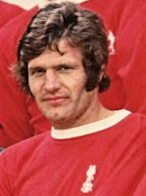
Liverpool tried to sign Frank Worthington from Huddersfield Town but he failed a medical and Bill Shankly turned his attention instead to a young Welshman with a growing reputation at his hometown club Cardiff City. In November 1970, 21-year-old Toshack arrived for a club record of £110,000. 'Tosh' endeared himself to the home public in only his second match when he thumped a headed equaliser into the Kop goal in the cauldron of a Merseyside 'derby' against Everton. Although Toshack 'only' scored seven times in 33 matches in his debut season at Anfield, it was clear that his aerial power would be an important part of Liverpool's attack for some years to come. But Toshack was more than just a tall target man. He could play a bit too as he would prove that time and time again. The arrival of Kevin Keegan before the 1971/72 season was a godsend for Toshack and Liverpool. They became the quintessential big target man and the smaller forward playing off him. A typical Liverpool attack was a pass from the wing, headed down by Tosh for his smaller accomplice Kevin Keegan to score.
Liverpool hadn't won a trophy under Shankly since 1966 but came close in 1971 and 1972 in the FA Cup and the Championship respectively. Arsenal beat Liverpool 2-1 in the 1971 FA Cup final and Liverpool and Arsenal drew 0-0 in the final League game of the 1971/72 season when Liverpool needed a win to snatch the title away from Derby and seal a record eighth League Championship. Toshack scored a legitimate goal against the Gunners but the offside flag was up to Shankly's disgust. Toshack was unlucky with injuries during his time at Anfield. He didn't suffer serious long-term injuries but usually niggling ones which meant that he only once played in 30 or more League matches in any of the six full seasons that he was a Liverpool player. Toshack missed 20 League games in 1972/73 but still scored 13 vital goals as the title was won after a tense struggle with Leeds and Arsenal. But it was in the UEFA Cup final of that year that Toshack made perhaps his most telling contribution. Left out of the starting line-up against Mönchengladbach on an evening when torrential rain caused the home leg to be abandoned after less than half an hour, he was brought in to replace Brian Hall 24 hours later and caused havoc in the Germans' defence, laying on two first-half goals for Keegan. He also played in the whole of the second leg in Germany two weeks later when, despite conceding two goals to Jupp Heynckes inside the first 30 minutes, Liverpool just held on to take their first European trophy 3-2 on aggregate.
Following Ray Kennedy's arrival and Shankly's retirement in the summer of 1974 Toshack lost his place in the starting line-up in the first month of the 1974/75 season. Toshack's frustration boiled over and on 21 November 1974 the club accepted a £160,000 deal for him to move to Leicester City. He, however, failed his medical and returned to Liverpool, which was a blessing in disguise. Three weeks later he recovered his place in the team and scored in his first three games back and didn't look back. The Reds were unable to retain their domestic crown in 1974 but ample compensation was achieved in the FA Cup when eight of the players who had tasted defeat against Arsenal three years earlier were named in the side to face Newcastle United. Toshack had already scored the only goal of a difficult quarter-final trip to second division Bristol City and the important third goal which sealed the semi-final replay victory against Leicester City at Villa Park. At Wembley, it was his flicked-header from Ray Clemence's long kick downfield which allowed Steve Heighway to run on and put Liverpool into a commanding 2-0 lead with only 15 minutes left to play. 1975/76 was Toshack's most productive and injury-free season on Merseyside. He only missed seven League matches, played in 50 competitive matches for the club in four different competitions and again won League and UEFA Cup winners' medals in the same season. He passed 20 goals in a season for the only time as a Liverpool player, scoring a hat-trick of headers against Hibernian in the UEFA Cup and also the goal which brought a famous win in Spain against Barcelona in the first leg of the semi-final. At 27 years of age, he should have been approaching his peak as a player but injury meant that he missed the last part of the 1976/77 season and he could only watch and admire as his colleagues won the European Cup for the first time.
After only making five appearances for Liverpool the following season, Toshack was on his way to Anderlecht for £60,000, but like when he wanted to move to Leicester, due to calcification of a muscle he failed his medical again. Toshack felt a management route would then be the ideal next step and convinced Liverpool to give him a free transfer. He returned to South Wales in February 1978 to become player-manager at Swansea City. He enjoyed outstanding success there in the club's meteoric rise from the Fourth Division to the First. Toshack proudly led his team out at Anfield on 3 October 1981, an afternoon of mixed emotions after the passing of Bill Shankly who had brought him to Merseyside nearly eleven years before. As the teams lined up for a minute's silence in memory of the great Bill Shankly, Toshack took off his Swansea tracksuit to reveal underneath a red Liverpool shirt with his number 10 on the back. It was a moment which endeared him to the Liverpool supporters who had seen him score nearly 100 goals for the club but not so to the Swansea supporters who were quite insulted.
Toshack had been a Welsh schoolboy international and was a member of his country's full international squad for many years, eventually finishing with 40 caps to add to the three he had won earlier at U-23 level. Although Swansea returned to the lower divisions almost as quickly as they had risen from them, Toshack's name and reputation had been noticed outside the United Kingdom and in the summer of 1984, he was named as the new manager of Sporting Lisbon. Although that post lasted less than a year, he later achieved success in Spain with both Real Sociedad and Real Madrid and is one of very few Britons to have won both league and cup competitions in another European country. In 1989 he flew back from Spain where he was managing Real Sociedad at the time and stood anonymously on the Kop in the aftermath of the terrible tragedy at Hillsborough so that he could pay his own respects to those who had died supporting the club which had given him his big chance.
Toshack was manager of Wales for the first time in 1994 but only spent 41 days in the post, resigning after a 3-1 defeat to Norway. He took charge of the Welsh national team again in November 2004. Toshack left the Wales post after his country's defeat to Montenegro in a European Championship qualifier in September 2010. Slightly less than a year later, however, he was unveiled as the new manager of FYR Macedonia. But John's association with Macedonia was only a brief one. After little more than a year, his contract was terminated, apparently because he refused to relocate to the country he was manager of. In March 2013 Toshack took over as manager of Khazar Lankaran of the Azerbaijan Premier League, remaining there until November that year. In 2014 he took over at Wydad Casablanca, winning the Morocco title in his first season but departed in 2016. Toshack took on his next managerial appointment at the age of 69 in June 2018, signing a three-year deal with Iranian side Tractor Sazi but left the club three months later. Toshack contracted Covid 19 in 2022 and spent two weeks in hospital on a ventilator.
In March 2026 Toshack's son Cameron, a coach in Thailand, announced that his father had dementia. He said "It's the short-term memory where we're seeing it – I speak to him most days and if we chat in the afternoon, he might not remember that we also spoke in the morning. But if I ask him about the Liverpool days, or [Real] Sociedad or [Real] Madrid, the detail is amazing. The other day he was telling me about a Real Madrid game against Arrigo Sacchi's AC Milan and exactly how he tweaked his midfield to deal with Marco van Basten. The game could have been yesterday, his memory was so clear."