
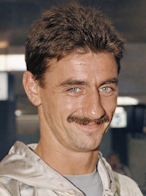
Ian Rush
Forward · Liverpool 1980–1987, 1988–1996
Personal
- Born
- 20 October 1961
- Place of birth
- St Asaph, Wales
- International
- 73/28 (67/26 at LFC) - 24.1.1996 Debut 21.05.1980 vs. Scotland
- Other clubs
- Chester (1977-80), Juventus (1986-88), Leeds United (1996-97), Newcastle United (1997-98), Sheffield United (loan 1998), Wrexham (1998-99), Sydney Olympic (1999)
At Liverpool
- Signed from
- Chester, Juventus
- Joined
- 28 April 1980
- Debut
- 13 December 1980
- First goal
- 30 September 1981
- Last goal
- 5 May 1996
- Last appearance
- 11 May 1996
- Left the club
- 20 May 1996
Also played against Liverpool — view opposition record
Liverpool career
- League 469 apps · 229 goals · 63 assists
- Win ratio 54.7% — W 361 · D 165 · L 134
Honours
Individual honours
- First Division top-scorer
- 1983-84
- PFA Team of the Year
- 1983 · 1984 · 1985 · 1987 · 1991
- European Golden Boot
- 1984
- PFA Players' Player of the Year
- 1984
- PFA Young Player of the Year
- 1983
- FWA Footballer of the Year
- 1984
Player profile
Simply the greatest goalscorer in Liverpool's history. Rushie was born and raised with four sisters and five brothers in a town called Flint in northeast-Wales. When he was 13 playing for Deeside Primary schools his scoring prowess alerted scouts at Liverpool and Manchester United. He eventually went on trials to Burnley, Wrexham and Chester. Cliff Sear, the youth team manager at Chester, put him at ease and Rush felt at home at Chester. Liverpool scout Geoff Twentyman was a regular visitor at Chester's games and come 1980 Bob Paisley was convinced enough about his talent to convince the club to splash out £300,000 on the 19-year-old which was the highest fee ever paid for a teenager at the time in the world. What clinched the deal for Rush was that Chester manager, Allan Oakes, told him: 'If you don't make it, you can always go back to Chester." Rush left Chester after scoring 17 goals in 39 matches. He made his debut for Liverpool in a 1-1 draw against Ipswich on 13 December 1980 replacing Kenny Dalglish in the side, who was out with an injured ankle. Wearing the famous number seven at Liverpool was quite a responsibility for the youngster, who was raised as an Everton supporter. Rush's second game was a League Cup final replay no less. He had an impressive game at Villa Park and rattled the crossbar. Liverpool celebrated a 2-1 win courtesy of Dalglish’s and Hansen’s goals. Rush finished the season with nine games for Liverpool but still no goals. He had though so far netted twelve goals in 30 reserve appearances.
Rush didn’t get a chance in the first team at the beginning of his first full season. He also had trouble adapting socially to his new surroundings. He was shy and didn’t like how Dalglish and the senior players used to wind him and the other new recruits up. Rush knocked on Paisley’s door and declared he wanted a chance with the first team or else he would leave. Paisley said he would make him available for transfer and Rush left his office determined to show him he could score an abundance of goals with the reserves that would alert other clubs. Rush scored five goals in his first four reserve games of the season. Paisley’s trick had worked as he never intended to sell him.
Rush broke his duck on 30 September 1981 at Anfield against Oulu Palloseura from Finland in the European Cup. He came on as a substitute and scored one of Liverpool's seven on the night. David Johnson got injured and Rush had a golden opportunity to establish himself in the side. Rush scored a brace against Exeter in the League Cup and netted another two goals in the League against Leeds and didn’t stop until he had scored 30 goals that season. The pinnacle was his first goal at Wembley in the League Cup final. Ronnie Whelan scored Liverpool's two goals in their 3-1 win over Tottenham. Whelan and Rush entered the side at a similar time and became firm friends. Their time had certainly come. Few believed Rush could sustain his current rate of scoring goals the next season, but he proved them all wrong and was voted the League’s most promising player in the 1982/83 season. Rush and Dalglish had formed a lethal partnership and their understanding of each other’s strengths was incredible. Rush was a quick runner and a quick thinker as well. He had made his move long before the opponent had realised. Sure enough Kenny rewarded his run with a brilliant pass and soon the ball was in the net. Rush soon earned the nickname "The Ghost" for the way he snuck up behind defenders. Rushie’s most memorable scoring feat that season was without a doubt his four goals in the derby match against Everton at Goodison Park. His destruction of the Blues was immortalised in song as an extra verse in "Poor Scouser Tommy" by Liverpool fans all over the world. Liverpool won the same double as the season before, the Championship and the League Cup.
The 1983/84 season was perhaps Rush's best for Liverpool. He scored a breathtaking hat-trick at Aston Villa, four against Coventry and five against Luton. Just before he went out on the field to score a quintette against Luton he soaked his rock hard boots in the bath. Every game since then he religiously wet his boots prior to kick-off. Liverpool fans would hardly believe if 90 minutes could pass without Rush scoring. He finished off Dinamo Bucharest in the semi-finals of the European Cup by a couple of goals. The final was a memorable one and Rush was one of four Liverpool players who scored in the penalty shoot-out in Rome. He had scored no less than 47 goals that season and was awarded the Golden Boot for being Europe’s top scorer. It was hardly surprising that his fellow professionals in England and the local media would choose him as the best player of the season. He had also destroyed Roger Hunt’s Liverpool record who had scored 41 goals in one season twenty years earlier. Rush was tempted to leave his beloved club for Napoli in 1984 as Rush revealed to LFChistory.net. "Napoli offered me £1 million and I wanted to speak to them just before the deadline. John Smith, the Liverpool Chairman, refused to do that." Napoli went on to sign Diego Maradona instead.
Rush suffered his first setback when he was sidelined for the first 14 games in the following season. His first game was against Everton but he drew a blank. Only a few days later he was back with a vengeance when he scored a hat-trick against Benfica in the second round of the European Cup. Rush repeated his feat from a year earlier when he scored two goals in the semi-final against Panathinaikos at Anfield, but the European Cup final at Heysel was a tragedy.
Liverpool captured the double in the 1985/86 season with Rush once again playing a key part, scoring twice in a 3-1 victory over Everton in the first-ever Merseyside final, which he rates as his most memorable game. Heartbreak for Liverpool fans worldwide was ahead. The Heysel tragedy resulted in a European ban for Liverpool and the club suffered financially for its exclusion from Europe. Liverpool were forced to part with their greatest asset for which they were going to receive a record fee for a British footballer, £3.2million. Rush was supposed to join Juventus in the summer of 1986, but Juventus president, Giampiero Boniperti, said to his great surprise during contract negotiations that he was going to be loaned out to Lazio in Serie B for the 1986/87 season as Platini had decided to play one more season. The French maestro and Michael Laudrup would occupy the two places allowed for foreigners at the Italian club. Rush suggested a loan to Liverpool to Boniperti. Those who feared Rush wouldn’t give 100% for the club in his final season soon calmed down. He scored 21 goals in his first 21 games. Incredibly Liverpool had never lost a game in which Rushie scored. The tally had reached 145 games when Liverpool faced Arsenal in the League Cup final. Rush gave Liverpool the lead but Charlie Nicholas replied with two and Arsenal ran out winners. Everton recaptured the Championship from their neighbours but not before Rush made them suffer at Anfield when he scored his eighteenth and nineteenth goal in twenty derby matches, equalling Dixie Dean’s record. Dixie achieved that feat in 17 matches, but Rushie went on to score a total of 25 goals against the Blues. Rush said goodbye to Liverpool by registering six goals in his final eight games.
The Welshman scored 14 goals for Juventus in the 1987/88 season of which eight were in Serie A. Diego Maradona was number one in the scoring charts with 14 league goals and Rush scored as many goals as Marco Van Basten and more than Rudi Voeller. He showed Juve fans what he was capable of when he scored four goals against Pescara in the cup. Injuries, illness, the defensive nature of the Italians and Michel Platini’s decision to quit Juventus all played a part in Rush's failure to deliver the goods on a regular basis. Peter Robinson was relaxing in the Spanish sun in 1988 when he spotted a magazine article that said talented striker, Alexander Zavarov, was on his way to Juventus and that meant there would be one foreign player too many at the Torino club. Robinson suspected who would be left out and immediately phoned Dalglish. Rushie’s return to Liverpool after only one season abroad came as a surprise to everyone and no one realised until he sat down with the manager in front of the stunned press that he had signed for his old club. Majority of the press believed that Liverpool were buying Gary Pallister from Middlesbrough to replace the injured Alan Hansen. The price was £2.8million so Liverpool had bought him for £400,000 less. Liverpool had run away with the League in the previous campaign and defences all around England were already quivering in their boots to meet up with Rush again, not least his neighbours across Stanley Park.
Once Rush returned he was clearly far away from his best condition. In January fans started to see glimpses of the old Rush. He scored in three games in a row but then he got injured and a knee operation meant two months on the sidelines. He proved a valuable substitute in the FA Cup final against his old foes Everton. John Aldridge made way for Rush in the second half having scored the only goal of the game until then. Stuart McCall equalized in the last seconds of full time. Rush scored Liverpool’s second with a brilliant shot in the fifth minute of extra-time but that was cancelled out by another McCall equalizer in the 102nd minute. Two minutes later Rushie proved to be the hero of the day when he scored with a dead accurate header and Liverpool won the Cup. Rush was preferred to John Aldridge in the starting line-up the following season and critics got on his back right away. The pressure was greater because Aldridge had been the team’s top scorer last season. He was not happy with the situation and signed for Real Sociedad in Spain where he continued to score on a regular basis. Rush didn’t let Kenny down and finished the season as top scorer with 26 goals. Like clockwork he scored the same amount of goals next season but Dalglish’s resignation spoilt Liverpool’s chances of holding on to their League title. Rush sustained an injury along with other key players in Souness’s first whole season in 1991/92. He managed to get himself fit for the FA Cup final against Sunderland and struck gold as usual at Wembley. He sealed Liverpool’s 2-0 win and his fifth goal in a FA Cup final was an unprecedented achievement.
Rush struggled along with others in the Liverpool side in the next two seasons but still delivered 41 goals. On 18 October 1992 Rush made another record his very own. He scored his 287th goal for Liverpool in a 2-2 draw against Manchester United at Old Trafford. Roger Hunt had to step down from his pedestal as Liverpool’s greatest goalscorer. Rush was in awe of Sir Roger. "Obviously I am proud and privileged to have beaten the record of a great player like Roger Hunt. He was my father's hero." Souness gave Rushie the captain’s armband he fully deserved in the autumn of 1993. He also received a new and promising strike-partner by the name of Robbie Fowler. They connected well and the Welshman took the young striker under his wing. Souness resigned in January 1994 and Roy Evans took over. Rush played his 600th game for Liverpool against Blackburn in the fourth round of the League Cup and celebrated by scoring his 16th hat-trick! Rush went on to score sixteen in total, one less than the club's hat-trick king, Gordon Hodgson. Steve McManaman proved instrumental in the final against Bolton and no one was more proud than Rushie to lift the cup as captain. In the summer of 1995 Liverpool bought the striking sensation that was Stan Collymore for a record fee. Rush was approaching his thirty-fourth birthday and the prediction was this was going to be his final season. Rush continued as captain and figured at the start of the season, but got sidelined through injury. Fowler and Collymore established a good rapport and the writing was firmly on the wall for the legend. Rushie’s achievements in the game were acknowledged by the queen at the turn of the year. He was awarded the MBE at Buckingham Palace. One more record gave way before Rushie left Anfield. On 6 January 1996 he scored against Rochdale in the third round of the FA Cup at Anfield. It was his forty-second goal in the competition and put him one above Denis Law with whom he had shared the record as the competition’s greatest goal-scorer in the twentieth century. Rochdale manager, Mick Docherty, was honoured to witness this monumental feat: "It couldn't happen to a better pro. He is a shining light in the profession because of his work rate, dedication and his great scoring record."
On 27 April 1996 Ian Rush played his farewell game at Anfield. He came on as a substitute in a 1-0 win over Middlesbrough but couldn’t get on the scoresheet. Rush was applauded by both sets of fans. He took his shirt off and threw it into the Kop. "It was an emotional day but also a fantastic day for me," Rushie said after the final whistle. "The reception I got will live with me forever. I'm sorry I didn't score. The fans were willing me to score and I wanted to score as much as they wanted me to. I wanted to stay on the pitch forever." He played his final League game against Manchester City and scored in a 2-2 draw. He looked forward to his final appearance that was appropriately enough at Wembley in the FA Cup final. Rush came on in the second half but a dull game ended 1-0 in Manchester United’s favour. A few days later he joined Leeds United. He was continually played out of position on the wing at Leeds and only recorded three goals for the Yorkshire club. In the summer of 1997 his old mate Dalglish lured him to Newcastle as well John Barnes. Rush scored two goals for Newcastle and both were historic. He scored his 49th goal in the League Cup which equalled Geoff Hurst’s scoring record and his second and last goal of his career at the top came against Everton in the FA Cup. Once more his old favourites were his victims. He was loaned out to Sheffield United in the spring and was hired as player-coach of Wrexham in the 1998/99 season. The legendary striker made couple of appearances with Sidney Olympic in Australia before retiring in 1999.
Ian Rush was also a star for his country. He played 73 internationals for Wales and scored 28 goals which is of course also a goalscoring record. His biggest disappointment was that he never got the opportunity to represent his country in the European Championships or the World Cup. Wales’ Ryan Giggs is amongst his biggest admirers: "As a schoolboy the three strikers I admired most were Ian Rush, Mark Hughes and Gary Lineker. But Rushie stood out because he was such an inspiring example to youngsters with so many other assets to his game." Rush has passed his FA coaching badges and travelled around the world to Australia and Iceland amongst other countries where he has taught kids to become accomplished goalscorers trying to pass on the knowledge he has gained. Houllier also recognised his coaching ability and added him temporarily to his Liverpool staff to help his strikers score goals.
Rush argued he was a better all-round player once he returned from Italy. He had certainly always impressed with his goalscoring talents but what made him stand apart was his defensive work. He was Liverpool's first defender when the opposition had the ball. Joe Fagan was always impressed by Rush's attention to teamwork. "He set an example to all his colleagues, not only in his scoring, but also in his willingness to tackle back. He wins the ball so often it provides a psychological boost for defenders." Rush scored 207 goals in 331 appearances in his first spell at Liverpool and added 139 in 329 games in his second phase at the club following his return from Juventus. Ian Rush is a unique striker at a club that prides itself on great forwards.
Appearances per season
| Season | League | FA | LC | Europe | Other | Total |
|---|---|---|---|---|---|---|
| 1980-1981 | 7 | 0 | 1 | 1 | 0 | 9 |
| 1981-1982 | 32 | 3 | 10 | 4 | 0 | 49 |
| 1982-1983 | 34 | 3 | 8 | 5 | 1 | 51 |
| 1983-1984 | 41 | 2 | 12 | 9 | 1 | 65 |
| 1984-1985 | 28 | 6 | 1 | 7 | 2 | 44 |
| 1985-1986 | 40 | 8 | 6 | 0 | 2 | 56 |
| 1986-1987 | 42 | 3 | 9 | 0 | 3 | 57 |
| 1988-1989 | 24 | 2 | 4 | 0 | 2 | 32 |
| 1989-1990 | 36 | 8 | 3 | 0 | 1 | 48 |
| 1990-1991 | 37 | 7 | 3 | 0 | 1 | 48 |
| 1991-1992 | 18 | 5 | 3 | 5 | 0 | 31 |
| 1992-1993 | 32 | 1 | 4 | 4 | 1 | 42 |
| 1993-1994 | 42 | 2 | 5 | 0 | 0 | 49 |
| 1994-1995 | 36 | 7 | 7 | 0 | 0 | 50 |
| 1995-1996 | 20 | 4 | 2 | 3 | 0 | 29 |
| Totals | 469 | 61 | 78 | 38 | 14 | 660 |
A more detailed look at the player's appearances
| Total | Started/substitutions |
|---|---|
| 630 | Started |
| 36 | Substituted |
| 30 | Substitute |
| 22 | On bench |
| Total | Venue |
|---|---|
| 317 | Home |
| 314 | Away |
| 29 | Neutral |
| Total | Competition |
|---|---|
| 339 | League |
| 130 | Premier League |
| 78 | League Cup |
| 61 | FA Cup |
| 25 | European Cup |
| 8 | UEFA Cup |
| 7 | Charity Shield |
| 4 | Screen Sport Super Cup |
| 4 | European Cup Winners Cup |
| 2 | Centenary Trophy |
| 1 | European Super Cup |
| 1 | World Club Championship |
| Total | W | D | L | Win% | Manager |
|---|---|---|---|---|---|
| 226 | 132 | 59 | 35 | 58.4% | Kenny Dalglish |
| 111 | 45 | 33 | 33 | 40.5% | Graeme Souness |
| 109 | 61 | 29 | 19 | 56.0% | Joe Fagan |
| 109 | 73 | 20 | 16 | 67.0% | Bob Paisley |
| 95 | 46 | 23 | 26 | 48.4% | Roy Evans |
| 10 | 4 | 1 | 5 | 40.0% | Ronnie Moran |
Goals per season
| Season | League | FA | LC | Europe | Other | Total |
|---|---|---|---|---|---|---|
| 1981-1982 | 17 | 3 | 8 | 2 | 0 | 30 |
| 1982-1983 | 24 | 2 | 2 | 2 | 1 | 31 |
| 1983-1984 | 32 | 2 | 8 | 5 | 0 | 47 |
| 1984-1985 | 14 | 7 | 0 | 5 | 0 | 26 |
| 1985-1986 | 22 | 6 | 3 | 0 | 2 | 33 |
| 1986-1987 | 30 | 0 | 4 | 0 | 6 | 40 |
| 1988-1989 | 7 | 3 | 1 | 0 | 0 | 11 |
| 1989-1990 | 18 | 6 | 2 | 0 | 0 | 26 |
| 1990-1991 | 16 | 5 | 5 | 0 | 0 | 26 |
| 1991-1992 | 4 | 1 | 3 | 1 | 0 | 9 |
| 1992-1993 | 14 | 1 | 1 | 5 | 1 | 22 |
| 1993-1994 | 14 | 1 | 4 | 0 | 0 | 19 |
| 1994-1995 | 12 | 1 | 6 | 0 | 0 | 19 |
| 1995-1996 | 5 | 1 | 1 | 0 | 0 | 7 |
| Totals | 229 | 39 | 48 | 20 | 10 | 346 |
The player scored 346 goals in 259 different matches.
A more detailed look at the player's goals
| Total | Opponent |
|---|---|
| 25 | Everton |
| 15 | Coventry City |
| 15 | Manchester City |
| 13 | Ipswich Town |
| 13 | Southampton |
| 13 | Tottenham Hotspur |
| 11 | Queens Park Rangers |
| 10 | Aston Villa |
| 10 | Chelsea |
| 10 | Nottingham Forest |
| 10 | Watford |
| 9 | Leicester City |
| 9 | Luton Town |
| 9 | Newcastle United |
| 9 | Norwich City |
| 8 | Birmingham City |
| 8 | Notts County |
| 8 | Sheffield Wednesday |
| 8 | Swansea City |
| 8 | West Ham United |
| 7 | Arsenal |
| 7 | Crystal Palace |
| 6 | Blackburn Rovers |
| 6 | Leeds United |
| 6 | Oxford United |
| 6 | Stoke City |
| 6 | Sunderland |
| 5 | Apollon Limassol |
| 5 | Benfica |
| 5 | Brighton & Hove Albion |
| 5 | Crewe Alexandra |
| 5 | Oldham Athletic |
| 4 | Exeter City |
| 4 | Fulham |
| 4 | Middlesbrough |
| 4 | Wimbledon |
| 3 | Barnsley |
| 3 | Derby County |
| 3 | Manchester United |
| 3 | Sheffield United |
| 2 | Brentford |
| 2 | Dinamo Bucharest |
| 2 | Millwall |
| 2 | Panathinaikos |
| 2 | Walsall |
| 2 | West Bromwich Albion |
| 2 | Wigan Athletic |
| 1 | Athletic Bilbao |
| 1 | AZ Alkmaar |
| 1 | Bolton Wanderers |
| 1 | Bristol City |
| 1 | Charlton Athletic |
| 1 | Chesterfield |
| 1 | Dundalk |
| 1 | Genoa |
| 1 | Oulu Palloseura |
| 1 | Port Vale |
| 1 | Rochdale |
| 1 | Widzew Lodz |
| 1 | Wolves |
| 1 | York City |
| Total | Started/substitutions |
|---|---|
| 340 | Started |
| 6 | Substitute |
| Total | Competition |
|---|---|
| 184 | League |
| 48 | League Cup |
| 45 | Premier League |
| 39 | FA Cup |
| 14 | European Cup |
| 7 | Screen Sport Super Cup |
| 5 | European Cup Winners Cup |
| 3 | Charity Shield |
| 1 | UEFA Cup |
| Total | Goal minute period |
|---|---|
| 44 | 1-15 minutes |
| 45 | 16-30 minutes |
| 38 | 31-45 minutes |
| 58 | 46-60 minutes |
| 67 | 61-75 minutes |
| 87 | 76-90 minutes |
| 7 | 91-120 minutes |
| Total | Assisted by |
|---|---|
| 39 | Kenny Dalglish |
| 20 | John Barnes |
| 15 | Ronnie Whelan |
| 14 | Steve Nicol |
| 13 | Craig Johnston |
| 12 | Jan Mølby |
| 11 | Peter Beardsley |
| 11 | Sammy Lee |
| 10 | Paul Walsh |
| 10 | Steve McManaman |
| 9 | Robbie Fowler |
| 9 | Steve McMahon |
| 7 | Graeme Souness |
| 7 | John Wark |
| 6 | Alan Kennedy |
| 6 | Michael Robinson |
| 6 | Rob Jones |
| 5 | Jamie Redknapp |
| 5 | John Aldridge |
| 5 | Phil Neal |
| 5 | Ronny Rosenthal |
| 4 | Kevin MacDonald |
| 4 | Ray Houghton |
| 3 | Alan Hansen |
| 3 | Barry Venison |
| 3 | David Burrows |
| 3 | David Hodgson |
| 3 | Gary Ablett |
| 3 | Glenn Hysén |
| 3 | Mark Lawrenson |
| 3 | Steve Staunton |
| 2 | Don Hutchison |
| 2 | Gary Gillespie |
| 2 | Jim Beglin |
| 2 | Neil Ruddock |
| 2 | Paul Stewart |
| 1 | David Johnson |
| 1 | Julian Dicks |
| 1 | Mark Walters |
| 1 | Michael Thomas |
| 1 | Mike Marsh |
| 1 | Phil Thompson |
| 1 | Stig Inge Bjørnebye |
| 1 | Terry McDermott |
Assists per season
| Season | League | FA | LC | Europe | Other | Total |
|---|---|---|---|---|---|---|
| 1981-1982 | 4 | 0 | 1 | 0 | 0 | 5 |
| 1982-1983 | 6 | 1 | 0 | 1 | 0 | 8 |
| 1983-1984 | 5 | 1 | 2 | 3 | 0 | 11 |
| 1984-1985 | 3 | 1 | 0 | 0 | 0 | 4 |
| 1985-1986 | 8 | 1 | 3 | 0 | 0 | 12 |
| 1986-1987 | 7 | 0 | 2 | 0 | 0 | 9 |
| 1988-1989 | 2 | 0 | 0 | 0 | 0 | 2 |
| 1989-1990 | 8 | 0 | 0 | 0 | 0 | 8 |
| 1990-1991 | 9 | 1 | 0 | 0 | 0 | 10 |
| 1991-1992 | 2 | 0 | 1 | 0 | 0 | 3 |
| 1992-1993 | 1 | 0 | 0 | 0 | 0 | 1 |
| 1993-1994 | 1 | 0 | 0 | 0 | 0 | 1 |
| 1994-1995 | 5 | 0 | 0 | 0 | 0 | 5 |
| 1995-1996 | 2 | 0 | 2 | 0 | 0 | 4 |
| Totals | 63 | 5 | 11 | 4 | 0 | 83 |
A more detailed look at the player's assists
| Total | Opponent |
|---|---|
| 6 | Everton |
| 6 | Queens Park Rangers |
| 5 | Aston Villa |
| 5 | Chelsea |
| 5 | Coventry City |
| 4 | Arsenal |
| 3 | Ipswich Town |
| 3 | Leicester City |
| 3 | Manchester City |
| 3 | Odense Boldklub |
| 3 | Oxford United |
| 3 | Southampton |
| 3 | Tottenham Hotspur |
| 2 | Birmingham City |
| 2 | Leeds United |
| 2 | Manchester United |
| 2 | Norwich City |
| 2 | Nottingham Forest |
| 2 | Notts County |
| 2 | Stoke City |
| 2 | West Ham United |
| 2 | York City |
| 1 | Brighton & Hove Albion |
| 1 | Crystal Palace |
| 1 | Derby County |
| 1 | Fulham |
| 1 | HJK Helsinki |
| 1 | Luton Town |
| 1 | Middlesbrough |
| 1 | Newcastle United |
| 1 | Oldham Athletic |
| 1 | Sheffield United |
| 1 | Swansea City |
| 1 | Walsall |
| 1 | Wimbledon |
| Total | Competition |
|---|---|
| 54 | League |
| 11 | League Cup |
| 9 | Premier League |
| 5 | FA Cup |
| 4 | European Cup |
| Total | For player |
|---|---|
| 10 | Kenny Dalglish |
| 8 | Craig Johnston |
| 7 | Peter Beardsley |
| 6 | John Barnes |
| 6 | Steve McMahon |
| 5 | John Wark |
| 4 | Michael Robinson |
| 4 | Ray Houghton |
| 4 | Robbie Fowler |
| 4 | Steve Nicol |
| 3 | John Aldridge |
| 3 | Ronnie Whelan |
| 2 | John Scales |
| 2 | Paul Walsh |
| 2 | Ronny Rosenthal |
| 1 | Alan Hansen |
| 1 | David Hodgson |
| 1 | David Johnson |
| 1 | David Speedie |
| 1 | Dean Saunders |
| 1 | Gary Gillespie |
| 1 | Graeme Souness |
| 1 | Jan Mølby |
| 1 | Michael Thomas |
| 1 | Neil Ruddock |
| 1 | Phil Neal |
| 1 | Sammy Lee |
| 1 | Steve McManaman |
Related Articles
Ian Rush arrives along with Money
Bob Paisley bought two promising players in the spring of 1980. One was to become a certified legend, the other one made 17 appearances in two years.
Howard Gayle - A pioneer and an activist
Howie Gayle is a trailblazer, an idealistic man who tried to break through at Liverpool FC at the height of their success.
Elite strikers
What does new signing Christian Benteke need to join the top frontmen in Liverpool FC's history?
John Peel Interviews Ian Rush
A transcript of the edition of Chain Reaction in which John Peel interviewed Liverpool striker Ian Rush. From 15 December 1992.
Small talk with Ian Rush
From the Guardian on 18.02.2011. Liverpool's record goalscorer on making Welsh rarebit, travelling the Middle East and The King's Speech.
Read the 60 mins interview with Ian Rush
LFChistory.net has exclusive access to LFC.tv's "60 minutes" in-depth interviews.
Ian Rush - A village boy from Wales
A few years ago we had the privilege of interviewing Ian Rush and now we conducted our second interview with this fantastic legend. His career was of course an eventful one so there was still enough to talk to him about the second time around.
Rafa had a look at Ian Rush as coach
LFChistory.net interviewed Ian Rush recently and here is an outtake from this exclusive interview that will be online next week.
In the bar with Ian Rush
Paul Hassall and Danny Elliott on LFC.tv on 12 March 2009.
Ian Rush on his proposed move to Napoli
From Ian Rush's autobiography.
I'd wanted to stay at Chester says Rush
The Liverpool legend reflects on his tentative Anfield start and how a formidable pairing with Kenny Dalglish blossomed in the 1980s From The Guardian on 14th October 2008.
Ian Rush scores five!
Liverpool destroyed Luton with an avalanche of goals at Anfield in the 1983//84 season. Ian Rush hitting five and Kenny Dalglish also joining in the champions super-show.
The truth behind my happy anniversary
Nov 6 2007 by Ian Rush, Liverpool Echo.
Super Focus on Ian Rush
A Shoot! Super focus from 1982.
Ian Rush scores and Liverpool still lose
Guardian article by Ian Rush recalling his record that ran its course on 05.04.87
Ian Rush - My perfect XI
An article from 442. Liverpool and Wales legend Ian Rush picks the best players he's ever had the pleasure - and displeasure - of sharing a football pitch with.
Red Rush rocks Rovers
Match report from British Soccer Week on Liverpool - on 30.11.1994.
Sparky's spree saves United
Match report from British Soccer Week on Manchester United - Liverpool on 18.10.1992.
Rush in the hunt for a record
Match report from British Soccer Week on Apollon Limassol - Liverpool on 16.09.1992.
Unhappy reunion for Rush
Match report from Press Association on Leeds - Liverpool on 16.11.1996.
Great matches: Rush got four!
Chris Wood reflects on the greatest matches in Liverpool's history.
Rush and Mølby done with the lower leagues - exclusive from LFChistory
LFChistory had a quick chat with Jan Mølby and Ian Rush the other day and asked whether they have any plans to become football managers again.
Nightmare for boss Souness
Match report from 04.12.1993 on Sheffield Wednesday - Liverpool from The Daily Express.
Liverpool legend Rush shows his class
Match report from 27.10.1993 on Liverpool - Ipswich from British Soccer Week.
Rush hits 200th goal
Match report from Liverpool - Leeds on 28.08.1993 from British Soccer Week.
Emotional farewell to goalscoring legend
Match report on 27.04.1996 from "Press Association"
Final flourish lures Rush
Article by Keith Pike of "The Times".
Rush enters the hall of fame
by Ken Gaunt of "Press Association"
Rush: the best there is
Match report from the Sunday Mirror on 05.04.1986.
Lisbon's eagles mauled by extraordinary predator
Match report from 24.10.1984 by The Times.
Ian Rush - The greatest goalscorer
An exclusive interview with Ian Rush by lfchistory.net.
Rushie's hat-tricks
Rush scored 16 hat-tricks for LFC, one less than record holder Gordon Hodgson.
Tribute from King Kenny
From "Celebration Year 1994/95 Ian Rush"