
Bill Shankly
Manager · Liverpool 1959–1974
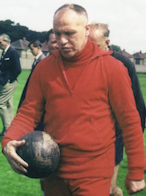
Personal
- Born
- 2 September 1913
- Place of birth
- Glenbuck, Scotland
- Died
- 29 September 1981
- Other clubs managed
- Carlisle United, Grimsby Town, Workington, Huddersfield Town
At Liverpool
- Arrived from
- Huddersfield Town
- Appointed
- 1 December 1959
- First match
- 19 December 1959
- Final match
- 10 August 1974
- Time in charge
- 14 years, 7 months
Liverpool record
- 609 league games · First match 19 December 1959 · Final match 10 August 1974
Season by season
Full season record →- 1959-60 3rd Div 2 from Dec 1959
- 1960-61 3rd Div 2
- 1961-62 1st Div 2 1 trophy
- 1962-63 8th
- 1963-64 1st 1 trophy
- 1964-65 7th 1 trophy
- 1965-66 1st 1 trophy
- 1966-67 5th
- 1967-68 3rd
- 1968-69 2nd
- 1969-70 5th
- 1970-71 5th
- 1971-72 3rd
- 1972-73 1st 2 trophies
- 1973-74 2nd 1 trophy
Final league position for seasons he finished; position at the end of his spell for seasons he didn't.
Honours
7 trophiesTrophy count excludes the Charity/Community Shield.
Individual honours
- LMA Manager of the Year
- 1973
Manager profile
Bill Shankly was a tremendous competitor as a player making his name at second division Preston North End after arriving from Carlisle United, one division below, in 1933 at twenty years of age. He eventually made his full debut for them on 9 December 1933 against Hull City and quickly established himself as a regular and a crowd favourite owing to his whole-hearted attitude and commitment to the side. At the end of the season Preston had gained promotion to First Division. In an otherwise disappointing season, in 1936/37, Preston had the satisfaction of reaching the FA Cup final. At Wembley they came up against a strong Sunderland team who ran out 3-1 winners. The following year, Shankly scored his first league goal for Preston in a 2-2 draw against Liverpool at Anfield on 2 February 1938. North End were again to reach the Cup Final that season and this time they ran out 1-0 winners against Huddersfield. It was the pinnacle of Shankly's playing career. When Shankly was at the peak of his powers seven years of his career were lost to World War II. Shankly, who was in the RAF, starred for Norwich, Luton, Arsenal and Partick Thistle in the war as well as playing a single game for Liverpool in a 4-1 win over Everton at Anfield. When full League football resumed for the 1946/47 season, Preston still held his registration, and it was at Deepdale where he resumed his full professional career after hostilities had ceased. Shankly was now viewed as being part of a pre-war generation. Many clubs were throwing in youngsters in an attempt to make a fresh post-war start. Shankly, still a hugely accomplished player, soon found himself on the fringe of things and would often find himself helping to bring on the kids in the reserves. In 1949, Shankly was Preston's captain as the side struggled in the First Division and was eventually relegated in the spring. Before the end of the campaign, Shankly's old club, Carlisle United offered him the chance to become their manager and he took it. When Tommy Docherty took Shankly's place in the Preston team, Shanks told him, 'Congratulations. You are now the greatest right-half in the world. Just put the number 4 shirt on and let it run round, it knows where to go.'
Shankly was never short of confidence in his own ability. Referring in his autobiography to his first managerial appointment at Carlisle United in March 1949, he said “I had the knowledge. I had been with people who knew how to train teams and I had my own conception of human beings and psychology.” His methods were certainly different from some of his contemporaries. Shankly was prepared to do any job however menial and instead of writing notes in the programme for the supporters to read, he preferred to use the tannoy to speak to them shortly before the start of each home fixture. Carlisle were a struggling Third Division North side who found it hard to attract southern-based players because of their geographic remoteness. Shankly immediately turned this disadvantage on its head and turned Brunton Park into something of a fortress. He would tell his players how tired the opposition must be at having to travel up to such a remote corner of the country. Carlisle was good for Bill Shankly and he for them as when he took over the club had won 14 games in the season,finishing fifteenth, but when he left it boasted 25 wins and third place. After a squabble with the club who had reneged on a bonus promise should the team finish in the top three, Shankly resigned. Grimsby Town had been relegated in 1951 and would be playing in Third Division North just as Carlisle but he wanted the job as "Carlisle did not have the money to make progress and because I thought there was more potential at Grimsby." Five months earlier Shankly had applied for a post in the First Division. George Kay had to resign from Liverpool due to health reasons and as Shankly recalled in his autobiography: "I got a telephone call from Liverpool and was asked if I’d like to be interviewed for the manager’s job.” Shankly wanted to put his own stamp on his team, but back in those days the members of the board had a big say in team matters. "The big snag had cropped up when the Liverpool board had said the manager could put down his team for matches and the directors would scrutinize it and alter it if they wanted to," Shankly explained. "So I just said, ‘If I don’t pick the team, what am I manager of?”
The Blundell Park outfit had been in the First Division in 1948 and was in free fall. The morale of the players and supporters of Grimsby was low. However, the players who had been at the club when Grimsby were in the top flight were still there, there being little point in players swapping and changing clubs in those days due to the maximum wage. Shankly was quickly able to use the raw material at his disposal to weld the players into a good side. In 1951/52, Grimsby just missed promotion, despite picking up an incredible 36 points out a possible 40 in the last 20 matches. The 1952/53 season started with much optimism around the club but the players still felt the disappointment of the previous season. The team too, was an ageing one, and struggled after a bright start and the season fizzled out. Shankly was given no money to buy new players and was reluctant to blood some promising reserves because of the loyalty he felt to these older stalwarts, a fault that was to surface at Liverpool years later. Disillusioned by events, he quit in January 1954, citing a lack of ambition by the club as his main reason.
Shankly was only a few days without a job after leaving Grimsby but had undoubtedly taken a step down the football ladder by taking over as manager at Workington. The club had only been a League side for two years and forced to to apply for re-election at the end of both seasons. At the end of the 1953/54 season, Shankly had lifted them to twentieth position, six points clear of re-election. Workington were transformed, playing a delightful brand of football. Season 1954/55 saw them finish a creditable eighth in Third Division North. Shankly had recharged the batteries that had run so low after his experiences at Grimsby and he was looking to step up the managerial ladder again. When he heard his old colleague from his Preston days, Andy Beattie was in trouble at first division Huddersfield, he was only too glad to tend his resignation at Workington on 15 November 1955 to go and help him out.
"If my father was my guiding light in life, Bill Shankly was my football mentor. Has there been anyone with a greater love for the game? If there has, I have yet to meet him. He was an established player when I first encountered him during my days as a junior. He invariably popped along to our matches. Bill would stop off anywhere a game of football was being played and, even at that early stage of his career, you knew he would go into coaching and management and make a damn good job of it." - Sir Stanley Matthews.
Shankly became assistant manager and coached the reserves at Huddersfield but on 5 November 1956, after the club had been relegated to the Second Division, Beattie left and Shankly took over as manager. On Christmas Eve 1956, Shankly gave a full first-team debut to one of the rising stars of the club, 16-year-old Denis Law. Shankly was unable to take Huddersfield back into the top division but was making a mark for himself as a manager. When Bill Shankly arrived at Anfield in 1959, Liverpool were in Second Division and going nowhere. The training ground, Melwood was a shambles, Anfield not a pretty sight and Liverpool overburdened with average players, but with quality players in the reserves. Shankly was immediately at home here as he sensed in the huge crowds a kinship with the supporters from the word go. They were his kind of people. With the backing of Bob Paisley and Joe Fagan and the enthusiasm of the fans behind him he set about rebuilding the team. Liverpool conceded seven goals without a reply in Shankly's first two games in charge. As well improving the club's training conditions Shankly cleared the squad of any dead wood. He tried to convince the directors at the club that Liverpool should spare no expense in strengthening the team. Finally 18 months after Shankly took over at Liverpool in came Yeats and St John, the two players he had wanted at Huddersfield. Shankly was quite confident that they would prove key signings. "St John and Yeats were both twenty-three, and I said to Mr Sawyer (Liverpool's financial director), 'You sack me if they can't play. I'm telling you now, I'll stake my life on it.'"
"In pre-season you got in an at Anfield and you then put a pair of trainers on," Tommy Lawrence said, recollecting life at Liverpool pre-Shankly. "They weren’t like trainers like you have today for running on the roads. They were pumps. You need to run from Anfield to Melwood. Around Melwood three or four times and then run all the way back. Roger Hunt and I used to travel with the train from Warrington and after about three days, we couldn’t even go down the steps, the backs of our calves were just gone. As soon as Shanks came he just changed it. ‘You play on grass and you will train on grass.’ And that was it. Then we actually saw a bag of balls. We had never seen a bag of balls." Ronnie Moran was an experienced campaigner but was very impressed by the new boss. "I learned more in the first three months than I'd done in the seven years that I'd been a pro. I wish I'd been five years younger."
Shankly felt Liverpool were ready for promotion with key players in place in defence and attack. If Liverpool were nervous it didn't show as they had opened up a seven-point lead in October. The Reds lost two games on the trot over Christmas with their lead down to just two points, but were soon back in the swing of things and ensured their long-awaited place in the First Division with five rounds to go with a 2-0 win over Southampton. Yeats told LFChistory.net that the 1961/62 season was the most vital one in his and arguably Shankly's career. "The most successful thing we did and I’ll say this always, was winning the Second Division. Without that nothing else would have happened, because we couldn’t progress without winning it." A season of consolidation followed in which Liverpool finished eighth, the only problem being Everton finishing as champions. As would happen again twenty years down the line, Liverpool and Everton were about to carve up the domestic honours between them in the next five or six seasons, but as the 1963/64 season started, it was Everton who were top dogs on Merseyside, a fact that rankled with Shankly. The Scotsman had the nucleus of side who had gained promotion two seasons previously but with the important addition of left-winger Peter Thompson. After a less than stellar beginning of the season Liverpool finally reached the top spot on 23 November 1963 following a win over Manchester United, their eighth in the last nine League games. The League title was secured with an incredible 5-0 win over Arsenal at Anfield with three games remaining of the season.
The following season Liverpool finished a disappointing seventh in the League with 13 less points than the previous campaign. Liverpool's participation in the European Cup took a lot of energy from them, only denied at the semi-final stage due to a dishonest referee in Milan. Liverpool were also doing brilliantly in the FA Cup, reaching their third final in the club's history. Liverpool had lost both their FA Cup finals to date in 1914 and 1950, but Shankly finally managed to bring the Cup home after St John headed in the winner. "Grown men were crying and it was the greatest feeling any human being could have to see what we had done," Shankly remembered. "There have been many proud moments. Wonderful, fantastic moments. But that was the greatest day." In season 65/66 Liverpool won the title again, easing up at the end, while neighbours Everton took the FA Cup. Liverpool lost the final of the European Cup Winners' Cup at Hampden Park to Borussia Dortmund. The great sixties side had gained promotion from Second Division, won the League twice, the FA Cup once, and progressed in Europe. It was a transitional time for the club. After that second title in 1966 the club didn't win the League again in that decade, but would not finish lower than fifth. for the rest of the decade. Shankly's mistake was to let the side rumble on without any major rebuilding too long. "We were all at the same age when we started so around ‘67 we were all around 30," Yeats explained to LFChistory.net. "He started to change the side, changing tactics, changing players, it took maybe three years to come together."
Not all of Bill Shankly’s signings turned out to be as successful as he would have liked. Alun Evans and Tony Hateley had short Anfield careers but Emlyn Hughes was someone who didn’t fall into that category. Shankly tried to sign him after watching him play in his very first professional match but had to be patient before he finally got his man. One cold afternoon in February 1970 Liverpool were dumped out of the FA Cup at second division Watford. “After Watford I knew I had to do my job and change the team," recalled Shankly. “It had to be done and if I didn’t do it I was shirking my obligations." Most of the old guard were phased out and in their place came the likes of Ray Clemence, Larry Lloyd, John Toshack, Steve Heighway and Brian Hall, not to mention the inspirational signing of Kevin Keegan from Scunthorpe United. These newcomers plus the younger players from the 60’s like Tommy Smith, Chris Lawler, Ian Callaghan and Emlyn Hughes who had survived the post-Watford cull would be the nucleus for his next great team who went on to win the UEFA Cup and the League in 1973 and the FA Cup in 1974.
It is terribly sad that after so much success, things became difficult between himself and the club he had served so well for nearly 15 years. Maybe there was fault on both sides? It was a difficult situation. “I still wanted to help Liverpool, because the club had become my life. But I wasn’t given the chance”, recalled Shankly. It looks as if the club wanted a clean break, that it felt things could become too complicated if Bill was still around. He continued to go to Melwood for a while but got the impression it would be better if he stopped going. He said he would have been honoured if he had been invited to become a Director of the club, which he surely deserved because of what he had achieved as a manager, but the offer never came. Bill Shankly seemed indestructible but he suffered a heart attack in the autumn of 1981 and died shortly afterwards on 29 September. His legacy can be seen at Anfield today, but not just in the gates that bear his name or the statue at the back of the Kop. Shankly was the catalyst that Liverpool Football club needed. Other men carried on the job that he started but he was the father of the modern-day Liverpool and did as much as anyone and more than most to turn them into one of the great powers of first English and then European football. The debt the club owes him can never be repaid.
The conclusion of Eric Todd's Guardian interview with Shankly in December 1968 revealed Bill's care for his players: "Before I left him, Shankly summoned the manager of a hotel and gave him his instructions. 'There'll be 17 in the party,' he said. 'So, that'll be 17 fillet steaks and I'll let you know how we want them done when we arrive - with chips. For afterwards, there'll be 17 fresh fruit salads and fresh cream. Right? Then for breakfast, eh ...' A players' man indeed."
More on Bill Shankly
Quotes 31
“I was like any other Liverpool fan, in awe of the team and in awe of Bill Shankly. Everyone knew that Shankly was creating a monster; this w…”
All quotes →Record
| Competition | Total | Won | Draw | Lost | Goals for | Goals against |
|---|---|---|---|---|---|---|
| Grand totals | 784 | 408 | 198 | 178 | 1308 | 767 |
| League | 609 | 319 | 152 | 138 | 1034 | 622 |
| FA Cup | 75 | 40 | 22 | 13 | 103 | 50 |
| League Cup | 30 | 13 | 9 | 8 | 51 | 35 |
| Europe | 65 | 34 | 13 | 18 | 114 | 54 |
| Other | 5 | 2 | 2 | 1 | 6 | 6 |
Related Articles
I couldn’t let Shankly miss Liverpool’s crowning glory
JEFF POWELL on the night he took legend to see his old club’s first European Cup win in 1977. Published in the Daily Mail on 26 May 2019.
Shankly on the Kop
16 months after leaving the managerial seat at Liverpool, Shankly returned to watch his beloved Liverpool on the Kop among the Reds faithful on 22 November 1975.
The Untold Story of Billy Howard - Part 2
Last week we introduced you to Billy Howard, an ardent Kopite who also had the pleasure and privilege to be on Liverpool Football Club's books. We hope you will enjoy reading this article as much as we enjoyed interviewing this gentleman.
Liverpool FC legend Bill Shankly's resignation letter revealed
Red or Dead
Chris Wood shares his opinion on the latest Shankly book by David Peace
250,000 bid for Shanks
Published in the Daily Mirror on 24 December 1976.
Peter Thompson - Shankly's wing wizard
Exclusive interview published in 2012.
Shankly's 40th anniversary
Celebrating the 40th Anniversary of Bill Shankly's arrival at Anfield. A mosaic across the top of the Kop spelt the word 'SHANKS'. Below were two images of Shanks' face flanking the Cross of St Andrew.
Shankly’s code wins title
The Daily Express on 20 April, 1964.
Shankly prepares for a new season
The Daily Mirror on 13 August, 1964.
Legend Shankly to be made Honorary Liverpool Citizen
From 17 December 2009.
Shanks the legend
On 16 December 2009 Bil Shankly was honoured as 50 years had passed since he signed his contract to become manager of Liverpool Football Club.
How could I forget Bill Shankly's first Liverpool FC game?
Written on 15 December 2009 by David Randles, Liverpool Echo.
Liverpool Echo memories of Bill Shankly
Liverpool fans remember Shankly on 2 December 2009.
Bill Shankly's grandaughter Karen Gill: I feel like I know him better now
By David Randles on 2 December 2009 in the Liverpool Echo.
Thommo salutes impact of Mr Liverpool
Celebrating 50 years of Shankly. Interview By Louise Goulding on 30 November 2009.
Shankly's Anfield farewell
Shankly said his final goodbyes to Liverpool fans at his testimonial amid scenes that will be forever etched in everyone's memory who was so lucky to be at Anfield on Tuesday evening 29th April 1975.
Paul Tomkins on Bill Shankly
Paul Tomkins' book, Dynasty, is a reassessment and an in-depth analysis of every manager of the club over the last 50 years.
Shankly would show withering contempt for the game today
Article written by Patrick Collins 1st October 2006 in memory of Bill Shankly 25 years after his death.
Thompson and Shankly
The relationship between Bill Shankly and the two-footed wizard winger, Peter Thompson, was quite complicated.
Ian St John - Raging Bull
LFChistory.net had the great pleasure of interviewing the Saint. I was a bit unprepared for our talk, but considering the circumstances coped pretty well.
Nessie was like a mum to us
Tommy Smith on Bill Shankly's wife, Nessie on 3rd August 2002.
The fighting philosophy of Bill Shankly
In an article from December 17 1968, now republished in The Guardian book of football, Eric Todd talks to the legendary Liverpool manager - a players' man who has always been 'daft about fitba'.
Boss Shankly didn't have a clue what the result was!
Liverpool drew West Ham 2-2 in the penultimate league game of the 1973-1974 season. Phil Thompson recalls a funny incident after the final whistle with Bill Shankly who clearly was oblivious to the result.
Ian St John has mixed feelings about Shankly
"Not so long ago, I found myself standing alone behind the Kop at Liverpool's football ground, staring intently at the bronze image of Bill Shankly. Bill Shankly, for me, will always be flesh and blood, human to a fault."
George Best's opinion on Bill Shankly
George Best's take on Shanks from his book 'The Best of Times'.
Then and Now: All thanks to Shanks 1960 to 1970 by George Scott
A former resereve team player at Liverpool shows his appreciation for Bill Shankly.
Shankly tricked Ray Clemence into signing for Liverpool
Bill Shankly convinced Ray Clemence that the first team's goalkeeper's position would be his and his only soon after his arrival. A slight exaggeration on Shankly's part.
Historic match: Shankly's first game in charge
Match report from News Chronicle and Daily Dispatch on Liverpool - Cardiff City 19.12.1959. This was Bill Shankly's first game in charge.
Shanks - memories of a great man
An article by Kevin Sampson on 29 September 2006. First published in Esquire magazine.
Ray Kennedy arrives in dramatic fashion
Ray Kennedy's official arrival at Liverpool couldn't have come in more dramatic circumstances.
Liverpool life in the 2nd division
John Martin followed the team's fortunes when the team got relegated in 1954.
The Bill Shankly Story by Wooltonian
Wooltonian's excellent portrayal of Shanks, the foundation on which Liverpool is based on.
Wooltonian's favourite Shankly quotes
Wooltonian, one of the most accomplished writers on the Net and in print on matters relating to Liverpool recalls his favourite Shankly quotes.
1964-1973: The Early Years
Republishing of the first chapter of Liverpool's exploits in Europe now including a video of the dramatic Inter Milan - Liverpool clashes where a certain Spanish referee bumped LFC out of Europe.
A Liverbird upon my chest
Robbie Ashcroft (aka Mottman) relives the infamous Charity Shield where Keegan got sent off.
Unique Programmes: Shankly Arrives
Having previously reviewed what is probably the most valuable Liverpool home match programme in monetary terms it is now worth looking at one that could be seen as being the most valuable in historic terms – that which saw Bill Shankly’s first match in charge of the Reds.
The letter from Shankly
Chris Wood received a letter from Shankly, visited him at his home and met him on a few different occasions. Here are his recollections of the GREAT man.
How Shankly helped St John to avoid a suspension
Chris Wood has been looking into aspects of LFC statistics for LFChistory that are often difficult to find and difficult to check... like players sent off and missed penalties etc.
Shankly's arrival
Mr Bill Shankly, manager of Huddersfield Town was last night appointed manager of Liverpool Football Club in succession to Mr Phil Taylor, who resigned on November 17.